liveBook · Manning

Failure classification

As explained in Think Distributed Systems

A scheme for grouping failures according to dimensions such as their location or time-related behavior.

Failure classification groups failures along two orthogonal dimensions: where they occur and how they behave over time. This turns failure analysis into a structured way to guide detection and mitigation. section 3.3.3

Use two complementary views:

  • Spatial classification locates a failure within a layered architecture, such as the application, platform, or infrastructure layer. section 3.3.3
  • Temporal classification distinguishes transient, intermittent, and permanent failures by their time-related behavior. section 3.3.3

Changing perspective across layers

An operating system treats hardware as its platform, while a database management system treats the operating system and hardware as its platform. The same component can therefore occupy different conceptual layers depending on the viewpoint. section 3.3.3
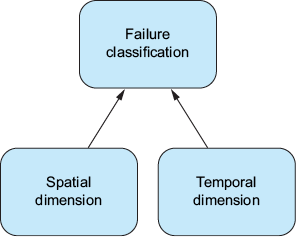
Figure 3.7 Failure classification
A diagram of a process

AI-generated content may be incorrect.

Use the classification figure to compare the spatial and temporal dimensions, then inspect the figures for layered location and transient, intermittent, or permanent behavior. section 3.3.3

How Think Distributed Systems covers it

How deep it goes
Distinguishes spatial and temporal dimensions, explains layered perspectives, and names transient, intermittent, and permanent behavior.
Examples
Uses operating systems, hardware, and database management systems to illustrate shifting application and platform perspectives.
What you can do after
Evaluate failures by locating them in layers and identifying whether their behavior is transient, intermittent, or permanent.
How it connects
Connects failure classification with layered architecture, application layers, platform layers, infrastructure layers, and temporal failure behavior.

Related concepts

This explainer was generated by Manning's knowledge graph from the text of Think Distributed Systems. The section links point to the parts of the book it draws on.