A failure domain, also called a fault domain, is a group of virtual machines sharing underlying infrastructure such as a power source, network switch, cooling, or rack. Separating VMs across fault domains reduces the chance that one infrastructure failure takes them all offline. section 3.2.1 section 3.5.2
Azure assigns VMs in an availability set to fault domains and update domains. Fault domains describe shared physical failure risk; update domains control which VMs can be rebooted during planned maintenance. Together, they support higher availability without requiring you to manage the hardware. section 3.2.1 section 3.5.2
Use the arrangement to balance resilience and cost:
- Create an availability set before creating the VM when you want Azure to distribute instances across fault and update domains. section 3.2.1
- Run VMs in separate fault domains so a disruption to shared power, cooling, or networking does not affect every instance. section 3.5.2
- Expect higher cost because resilience requires multiple VM instances, then weigh that cost against the workload’s importance. section 3.5.2
A rack-shaped failure boundary
Imagine three VM groups placed in physically separate racks. If one rack loses power or networking, VMs in the other fault domains can continue serving users—less “crash and burn,” more graceful wobble. section 3.2.1 section 3.5.2
Figure 3.30 An Azure availability set with three fault domains and five update domains
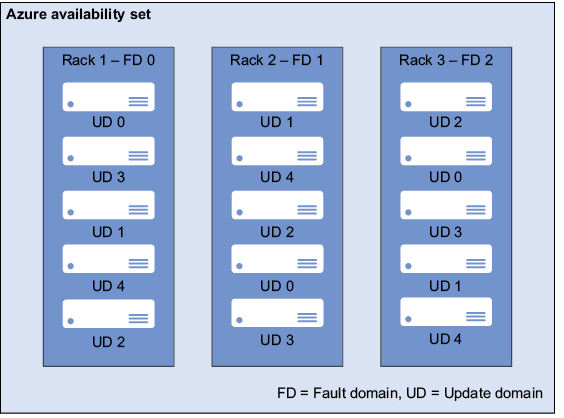
Visualizes an availability set with three fault domains and five update domains, showing how physical-failure separation differs from maintenance grouping. section 3.5.2
