liveBook · Manning

Fair information practice principles

As explained in Introduction to Generative AI, Second Edition

Fair Information Practice Principles are internationally influential privacy principles governing personal-data collection, use, disclosure, accuracy, security, and accountability.

Fair Information Practice Principles (FIPPs) are privacy principles for governing personal-data collection, use, disclosure, accuracy, security, and accountability. They emerged from concerns about government databases in the 1970s and became influential across national privacy frameworks. section 3.14

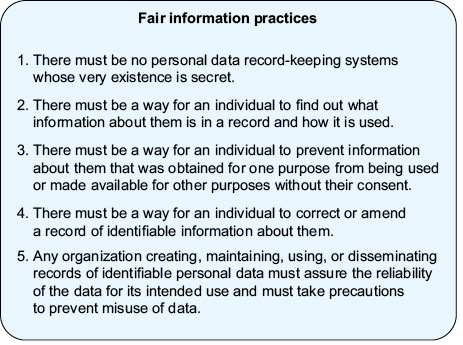
The original Fair Information Practices proposed in the United States in 1973 centered on:

  • Collection limitation: restrict unnecessary collection of personal data. section 3.14
  • Disclosure and secondary usage: govern how data is shared and reused. section 3.14
  • Record correction: support accuracy by allowing personal records to be corrected. section 3.14
  • Security: protect personal data from improper handling. section 3.14
  • Accountability: extend responsibility for data protection beyond the original five principles. section 3.14
Figure 3.3 Five core principles of FIPs [67]
A close-up of a paper

AI-generated content may be incorrect.

A visual summary organizes the five original Fair Information Practices. section 3.14

How Introduction to Generative AI, Second Edition covers it

How deep it goes
Defines five original principles and later accountability, while stopping short of detailed operational requirements.
Examples
Uses government databases, the 1973 US Fair Information Practices, and Figure 3.3's five-principle summary.
What you can do after
Evaluate privacy frameworks by identifying limits on collection, disclosure, reuse, correction, security, and accountability.
How it connects
Connects privacy principles with data protection laws, the Privacy Act, OECD principles, the Data Protection Directive, and GDPR.

This explainer was generated by Manning's knowledge graph from the text of Introduction to Generative AI, Second Edition. The section links point to the parts of the book it draws on.