Fair-share scheduling distributes CPU usage equally among users or groups rather than equally among individual processes. When a new user arrives, the scheduler reapportions available CPU cycles across all users. section 6.2.2
For distributed model-training clusters shared by multiple teams, it gives each user or group a resource pool so concurrent jobs do not interfere with one another. The policy can be applied at process, user, and group levels. section 6.2.2 section 6.2.3
Divide capacity by groups, then users
With three groups, each receives 33.3% of CPU cycles. If the groups contain three, two, and four users, their per-user shares are 11.1%, 16.7%, and 8.3%, respectively. section 6.2.2
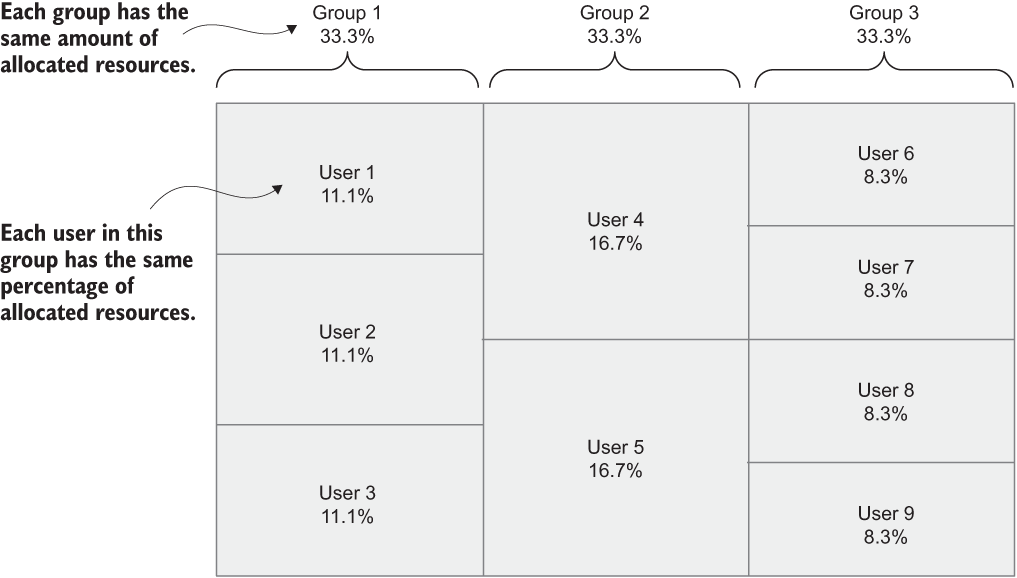
Compare per-user CPU allocations after equal capacity is assigned to each group and then divided among its members. section 6.2.2
Fair-share scheduling fits alongside other cluster scheduling policies:
- Priority scheduling executes jobs by priority and can preempt lower-priority work; administrators may need rules and limits to prevent abuse. section 6.2.3
- Gang scheduling waits until communicating workers are ready together, which suits collective-communication training but not elastic scheduling. section 6.2.3
