When a bot repeatedly says it does not understand, users can get stuck. A fallback provides another route when the primary flow cannot handle an input. section 2.1.1
Choose a fallback route that fits the failure:
- Ask the user to rephrase, but limit repeated prompts and offer a human agent when needed. section 2.1.1
- Handle low-volume requests through escalation, search, or generative AI rather than expanding a classifier to every topic. section 4.1.3
- For retrieval-augmented generation, offer a human agent if retrieved results are insufficient or unsuitable; do not generate an answer from them. section 6.4.5
- Distinguish an unrecognized request from an understood but out-of-scope request, which may be routed to a suitable agent or queue. section 11.4.2
Limit repeated failures
Cake Bot initially responds to any input with “I’m afraid I don’t understand. Please rephrase your question.” After repeated failures, it offers a human agent. The team lowers the threshold so users do not get stuck. section 2.1.1
Figure 11.10 A typical opt-out retention pattern will try to find out what the user needs. It will either recognize an in-scope request (a request that it is equipped to handle) or an out-of-scope request (a request that it understands but is not equipped to handle), or it will not recognize the request. When an in-scope request is recognized, the bot may make an incentivized offer to keep the user in-channel. When an out-of-scope request is made, the bot can route the user directly to the appropriate skill or agent queue. When a request is not recognized, the user is routed to a default or general hold queue.
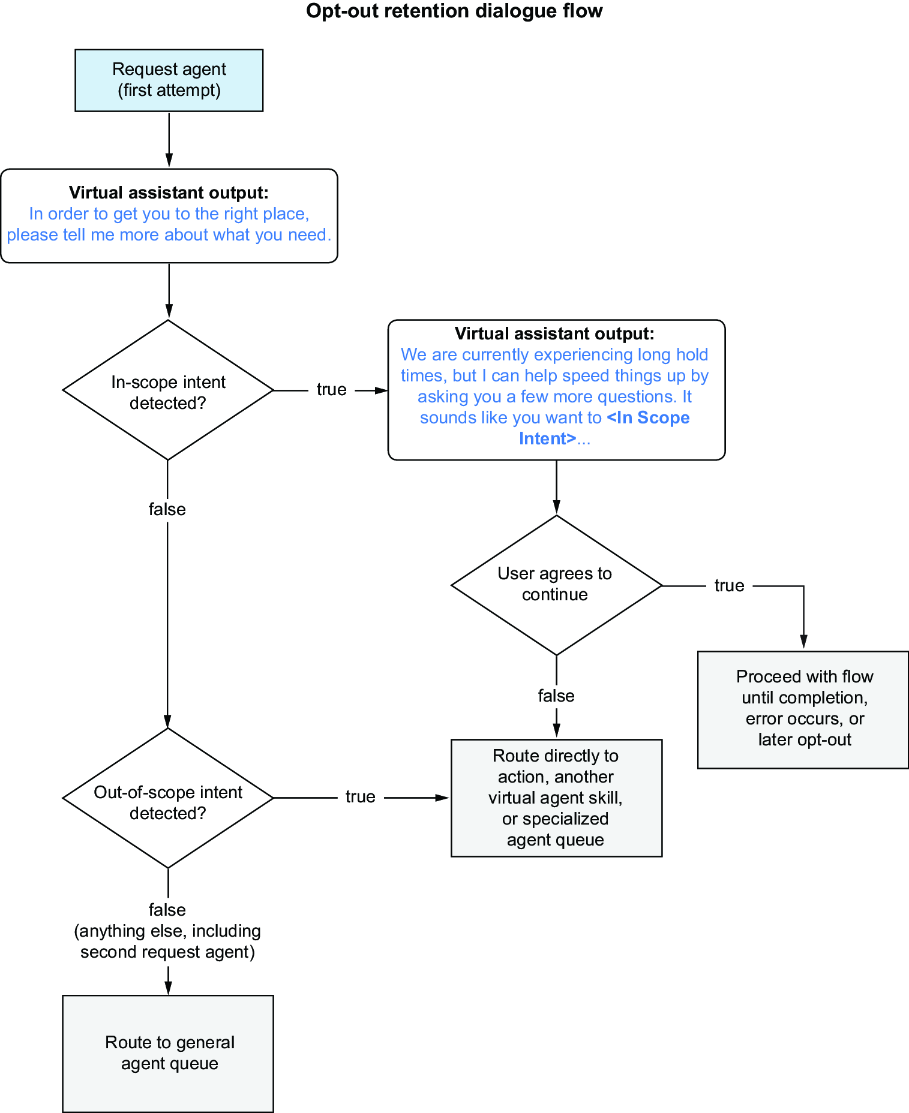
Use this flow to compare handling for in-scope, out-of-scope, and unrecognized requests. section 11.4.2














