Fan-in is a workflow pattern in which one aggregation step combines results from multiple upstream steps. It helps compose maintainable machine-learning workflows when several model-serving branches produce complementary predictions. section 5.2.2 section 5.9
Aggregating predictions from selected models
A workflow trains several models, selects the top two with at least 90% accuracy, runs separate serving steps, and aggregates both prediction results for users. Combining models that recognize different entities can cover more entities than either model alone. section 5.2.2
Figure 5.13 A diagram of the fan-in pattern, where we have one single aggregation step that combines the results from the two model serving steps
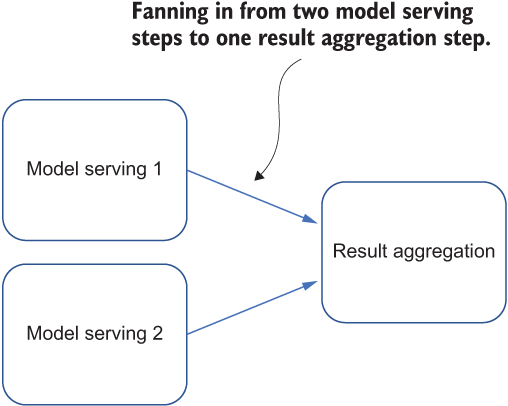
The diagram isolates the fan-in join: two model-serving outputs converge on one aggregation step. section 5.2.2
Use fan-in where its upstream work fits these operational constraints:
- Branches are independent, so they can run separately rather than as a sequential chain. section 5.2.3
- Branch completion and return order do not matter to the combined result. section 5.2.3
- Avoid it for a dependent ensemble-training step that must wait for other training steps to finish, adding delay. section 5.2.3

