Fast flow is the rapid movement of work through a value stream with minimal delays, dependencies, and interruptions. It depends on jointly optimizing team organization and software architecture, not on architecture alone. section 6.1.1 section 11.0
Create conditions for fast flow by:
- Aligning a value stream to a loosely coupled business subdomain and a purposeful business outcome. section 6.1.1
- Giving an autonomous, long-lived team responsibility for discovering, building, deploying, and supporting its solution. section 6.1.1 section 11.6
- Reducing dependencies through cohesive domain boundaries, decoupled architecture, and carefully managed cognitive load. section 9.1 section 11.6
- Treating speed as sustainable: maintain high delivery velocity while keeping code healthy, reliable, and recoverable. section 11.1.1 section 11.6
Loyalty levels in a travel company
A loyalty-levels feature changes loyalty accounts, loyalty points, and rewards. If those concepts span three subdomains, codebases, and teams, coordination slows delivery. Modeling them as one cohesive domain lets one team change one codebase, reducing dependencies and accelerating the flow of change. section 9.1
From zero to production
Taking weeks or months to deploy a new application blocks flow and can encourage teams to force new capabilities into an unsuitable existing codebase. A secure paved road that reaches production in hours or minutes removes that delay, while domain boundaries still constrain unnecessary service creation. section 13.1.1 section 13.2
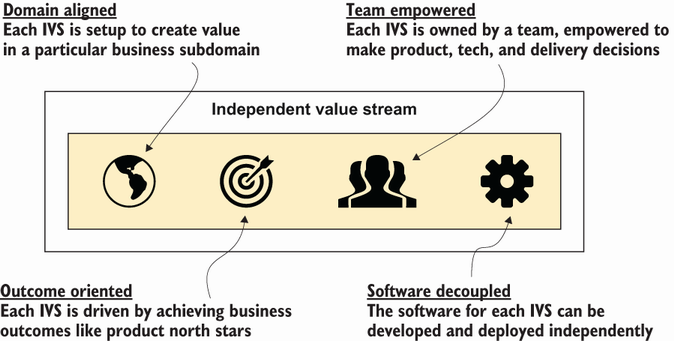
Use the four-characteristic model to assess whether a candidate value stream has the business alignment, autonomy, and architectural decoupling required for fast flow. section 6.1.1
