Faster R-CNN is a two-stage object detector that replaces CPU-bound selective search with a learned region proposal network. A convolutional backbone extracts feature maps; the RPN proposes regions, and a Fast R-CNN module classifies and localizes objects from them. The RPN and detection module share convolutional layers, improving efficiency and proposal quality. section 11.3.3 section 11.4
The detection pipeline combines these components:
- The convolutional backbone converts an input image into feature maps. section 11.4
- The region proposal network operates on the feature maps and emits candidate regions across multiple scales and aspect ratios. section 11.4 section 11.5
- RoI pooling converts regions of varying sizes into fixed-sized feature vectors. section 11.4
- Fully connected layers produce softmax scores for object classes plus background and bounding-box coordinates for each class. section 11.4
- Non-maxima suppression removes duplicate overlapping detections. section 11.5
Training must preserve the shared convolutional backbone. Alternate optimization trains the RPN and Fast R-CNN in repeated rounds; approximate joint training merges them, combines their losses, and backpropagates together while treating generated proposals as fixed. Joint training is faster but ignores the derivative through the proposal-generation step. section 11.4.4 section 11.4.4
A forward pass
An image first becomes a convolutional feature map. The RPN evaluates sliding-window locations with multiple anchor boxes and proposes candidate regions. RoI pooling turns those regions into uniform vectors, which the classifier labels and the regressor refines into bounding boxes before overlapping results are deduplicated. section 11.5 section 11.5
Figure 11.12 architecture. (Source: “Faster R-CNN: Toward real-time proposal networks”; https://arxiv.org/abs/1506.01497.)
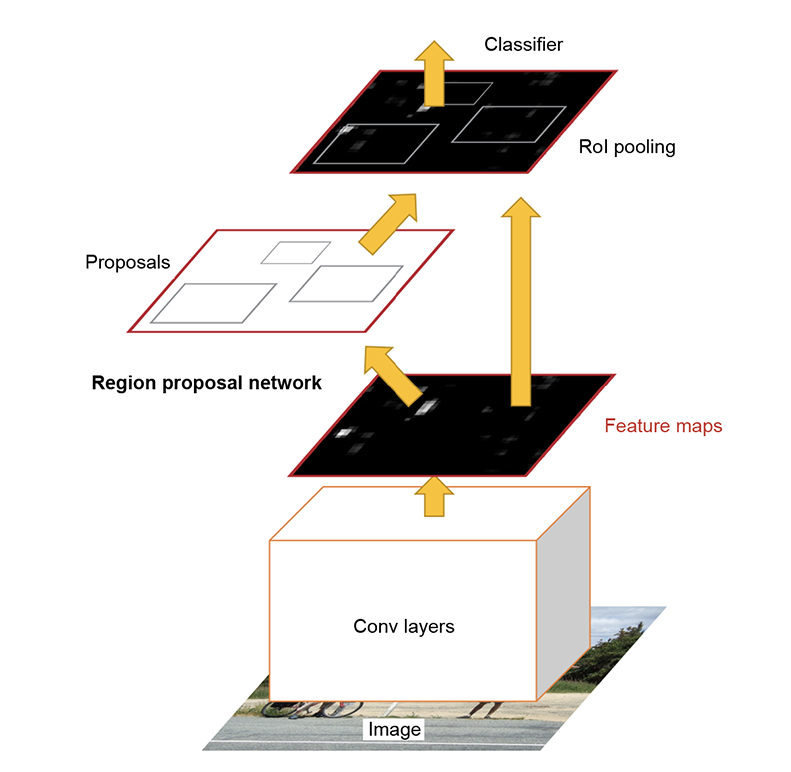
Use the architecture figure to follow the shared convolutional backbone from image features through RPN proposals, RoI pooling, classification, and regression. section 11.4

