Fault injection deliberately perturbs a system’s physical or electrical conditions to influence its output. In a ring-oscillator TRNG, an attacker can inject power-supply noise near the oscillator’s frequency, causing it to lock onto that frequency and produce predictable bits. section 2.2.1
Reduce the impact of noise-injection attacks by:
- Adding a binary transition counter and exposing raw counter bits to detect abnormal output bias. section 2.2.1
- Adding physical barriers, such as potting, to increase the attacker’s distance from the chip. section 2.2.1
- Combining TRNG output with a protected flash seed and refreshing that seed through a CSPRNG. section 2.2.1
Power-supply frequency injection
A sine-wave generator applies noise close to a ring oscillator’s frequency. The oscillator follows the injected signal, making the TRNG’s output trivial to guess. section 2.2.1
Figure 2.6 A ring oscillator
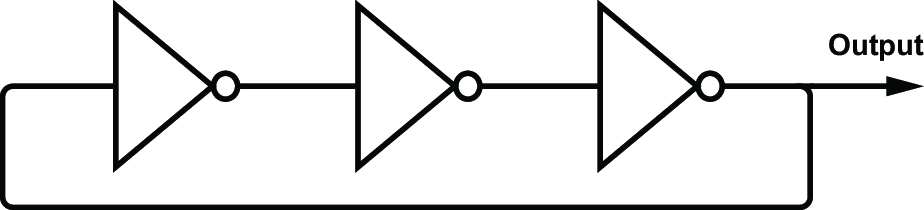
Use the ring-oscillator figure to connect the vulnerable physical oscillator to the fault-injection mechanism. section 2.2.1
