An order-processing system cannot stop whenever a downstream service fails. Kafka’s persistent, distributed event log lets a consumer resume where it left off and replay stored events. Its distributed design also lets a cluster continue handling data when parts of the system fail. section 1.1
For Kafka Connect, fault tolerance depends on where tasks can run. Workers in Distributed Mode share a group.id and coordinate task assignments. If a worker crashes, the remaining workers redistribute its tasks; adding a worker redistributes work for scaling. A connector that reads only a worker’s local files is a poor fit for this approach, so the FileStreamSource connector is not recommended for production. section 11.3
Distribute a database import
To import 12 database tables, set tasks.max to 4: each task can handle three tables, and Connect distributes the tasks across workers. The tasks provide parallel work; multiple workers give Connect places to reassign that work after a worker failure. section 11.3
Figure 11.4 A Kafka Connect cluster consists of one or multiple workers. Tasks are distributed across workers, and Kafka Connect uses three topics to store its internal state.
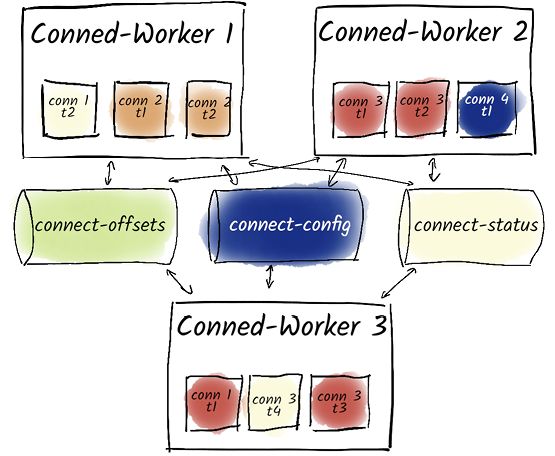
The cluster diagram shows tasks spread across workers and three topics holding Connect’s internal state. section 11.3
A running worker does not mean every record can be processed. Choose an error policy for the data and external systems involved:
- By default, a connector fails on an error. Setting errors.tolerance to all skips faulty records instead; enable errors.log.enable and consider alerts so skipped work remains visible. section 11.6.2
- For a sink connector, errors.deadletterqueue.topic.name can direct faulty messages to a dead-letter queue. Enable errors.log.include.messages only after considering whether records contain sensitive data. section 11.6.2
- For temporary access problems, configure errors.retry.timeout and errors.retry.delay.max.ms. The retry timeout defaults to zero, so retries must be enabled deliberately. section 11.6.2
At enterprise scale, fault tolerance is also a workload-planning concern. A global retailer might separate transactional, inventory, and analytics workloads into Kafka clusters so each can grow without overloading one shared cluster. This is a reason to split workloads, not a substitute for configuring worker recovery and record-error handling. section 18.4.4 section 11.6.2




