liveBook · Manning

Feature pyramid network

As explained in Deep Learning with R, Third Edition

A feature pyramid network is a neural-network architecture that combines semantically rich low-resolution features with spatially detailed high-resolution features at multiple scales.

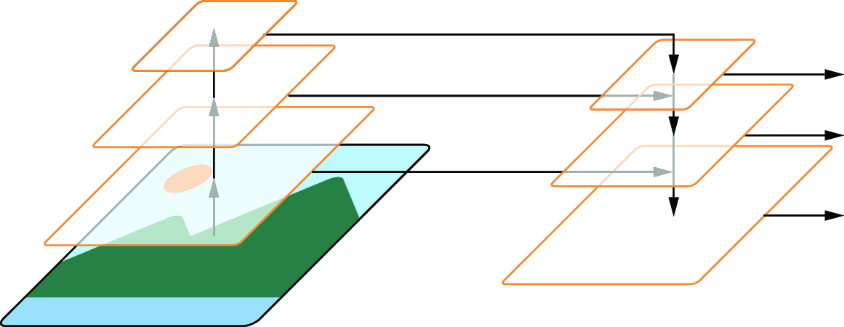
A feature pyramid network (FPN) helps object detectors recognize both small and large objects by combining detailed high-resolution features with semantically rich low-resolution features. section 12.3

An FPN upsamples final convolutional features through progressive Conv2DTranspose layers, then adds lateral connections from same-sized earlier feature maps. section 12.3

Use an FPN through pretrained RetinaNet

A pretrained RetinaNet model exposes FPN-based detection through KerasHub: `detector <- keras_hub$models$ObjectDetector$from_preset("retinanet_resnet50_fpn_v2_coco", bounding_box_format = "rel_xywh")` `predictions <- predict(detector, list(image))` The returned predictions include bounding boxes, confidence scores, labels, and the number of detections. section 12.3

Figure 12.8 An FPN creates semantically interesting feature maps at different scales.
figure

Use the architecture sketch to see how semantically meaningful feature maps are produced at multiple spatial scales. section 12.3


How Deep Learning with R, Third Edition covers it

How deep it goes
Explains feature fusion through upsampling and lateral additions, without deriving training objectives or implementation internals.
Examples
Uses pretrained RetinaNet inference on a Pointillist painting, with bounding-box visualization and COCO labels.
What you can do after
Operate/configure a pretrained RetinaNet detector through KerasHub and inspect its multiscale detection outputs.
How it connects
Connects convolutional neural networks, object detection, RetinaNet, and YOLO through multiscale feature maps.

Also explained in

Compare how 2 books explain feature pyramid network →

Related concepts

This explainer was generated by Manning's knowledge graph from the text of Deep Learning with R, Third Edition. The section links point to the parts of the book it draws on.