Feature retrieval obtains the values a model needs for an entity at a specified time, for training or inference. Historical retrieval must select values valid at that time rather than simply use the latest available values. section 4.2
A Feast retrieval component follows a practical sequence:
- Register features with sources accessible from the pipeline environment. section 5.1.1
- Provide an entity dataframe and the requested feature list to Feast’s historical retrieval method. section 5.1.1
- Save the retrieved dataframe as a pipeline dataset for a later step. section 5.1.1
Selecting historical values
For a user requested on May 22, with feature records from January 7, May 21, and December 4, retrieve the May 21 values—the latest record before the requested date. section 4.2
Figure 4.10 Feast feature store design involves a feature pipeline populating the offline store and periodically Feast materializes the offline features to the online store. The feature registry holds feature definitions along with online and offline store information. The Feast SDK provides methods to retrieve features from online and offline stores, which can be used for training and inference purposes.
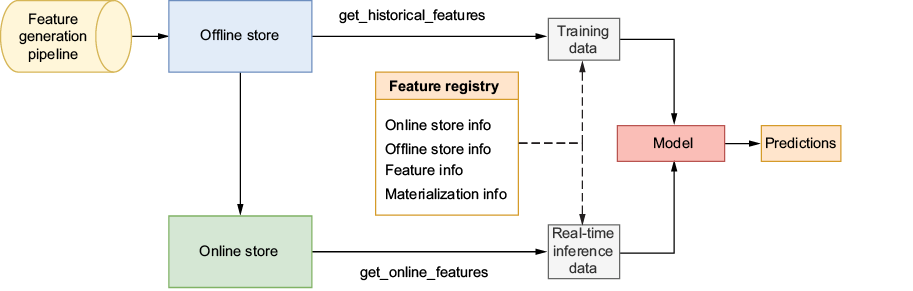
The diagram shows how an offline store, online store, feature registry, and Feast SDK support retrieval for training and inference. section 4.2
