A music app displays its most-played songs. Listeners pick from that prominent list, adding more plays and helping those songs remain popular. The display shapes the behavior that later shapes the display. section 1.3.3
A feedback loop is a cycle in which outputs influence later inputs. In a recommender system, recommendations shape what people see and interact with; those interactions become signals used to generate future recommendations. Users’ preferences can change too, so both sides of the relationship evolve. section 1.0 section 4.6.2
Figure 1.1 The feedback loop between user and recommender systems. Users and recommender systems are in a mutual feedback loop, with the output of one serving as the input to the other. The output of the algorithm, the recommendations, is the input for the users. The users’ output, what they engage with, is a signal for the recommender. On top of that, both the user and the recommender system update their internal state. Users change their minds and evolve their preferences over time, while algorithms learn users’ preferences and try to align more with them.
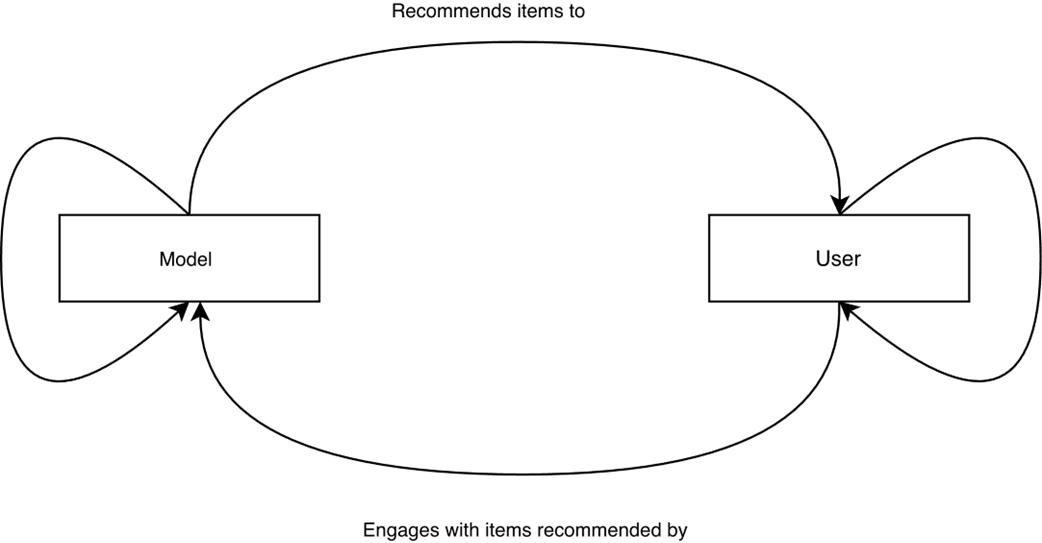
The diagram traces how recommendations and user behavior feed into each other as both users and the system change. section 1.0
A recommendation pipeline delivers ranked results and records interactions—or their absence. Likes, time spent viewing, and other behavior can help infer preferences without asking users to list them explicitly. But people choose from what they are shown, not from an unbiased sample of everything available. section 2.2 section 1.0 section 4.6.2
A social media feed
A feed that gives more weight to friends you interact with can show you more of their updates. Seeing those updates may prompt further interaction, which in turn can support their continued prominence. section 1.2.2
The cycle can reinforce popularity and may drive recommendations toward more extreme content over time. Engagement is not the same as value: clickbait can attract attention without being useful or worthwhile. section 1.0 section 1.3.3
Feedback also makes impact hard to measure. Preferences are inferred from behavior already shaped by past recommendations, making the contributions of users and algorithms difficult to disentangle. Measuring algorithmic amplification requires a baseline, but no universal baseline exists for personalized recommendations. section 4.8 section 4.6.2
When a prediction changes what is measured
A weather forecast does not change the weather. By contrast, allocating police using reports and arrests can change where officers are present; arrests also involve discretion, so they are not a purely objective measure of crime. section 4.6.1

