liveBook · Manning

File-level metadata

As explained in Architecting an Apache Iceberg Lakehouse

Metadata describing individual data files, including their locations and query-relevant statistics.

File-level metadata is the Iceberg layer that describes individual data and delete files, including their paths, partitions, and statistics. Query engines use it to exclude irrelevant files during planning instead of inspecting the entire dataset. section 2.3 section 11.1.2

Its implementation supports several architectural and operational tasks:

  • Connects manifests to individual Parquet files within a dataset. section 2.3
  • Stores file paths, partitions, and statistics so engines can prune data before scanning. section 2.3
  • Exposes active data and delete files through queryable metadata views backed by the Iceberg SDK. section 11.1.2
  • Enables maintenance decisions such as triggering compaction when too many files fall below a target size, such as 20 MB. section 11.1.2
Figure 2.4 Engines use metadata statistics to exclude data files from scans, speeding up queries.
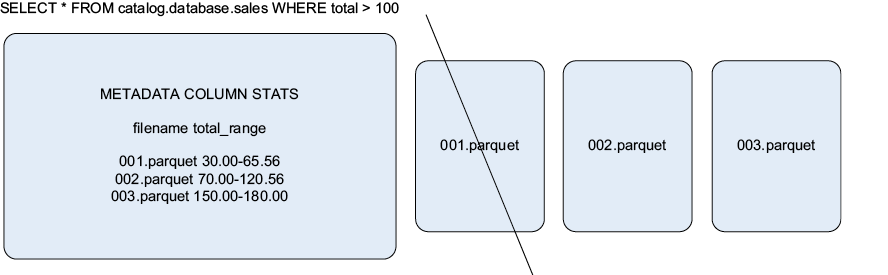
Shows how file statistics exclude data files from scans and improve query speed. section 2.3

How Architecting an Apache Iceberg Lakehouse covers it

How deep it goes
Defines manifests, file attributes, metadata views, and size-based compaction triggers without detailing the underlying file format.
Examples
Uses Parquet file listings, file statistics, metadata views, and a 20 MB threshold for conditional compaction.
What you can do after
Operate/configure metadata-aware maintenance by counting small files and triggering compaction only when fragmentation exceeds a limit.
How it connects
Links Apache Iceberg with manifests, Parquet files, query pruning, metadata views, snapshots, and compaction.

Related concepts

This explainer was generated by Manning's knowledge graph from the text of Architecting an Apache Iceberg Lakehouse. The section links point to the parts of the book it draws on.