A filled shape is a bounded region whose interior is marked rather than left empty. On paper, those marks may be ink dots; on a screen, they may be pixels. Lines and filled shapes are the small marks from which more complex text and graphics can be built. section 1.0 section 1.3
The practical problem is turning a compact description of a shape into the particular dots needed on a page or screen. This matters when the same shape must be drawn at different sizes or on devices with different resolutions: a circle can be described by a radius and coordinates, then converted into ink dots or pixels. section 2.0
Letters as filled shapes
A page of type is made from many tiny filled shapes: glyphs for letters, numbers, and punctuation. A typeface supplies those shapes, including separate designs for Roman, Italic, Bold, and Bold Italic styles. section 9.0
Figure 1.12 A shape filled first with black and white dots and then with dots of differing shades of gray
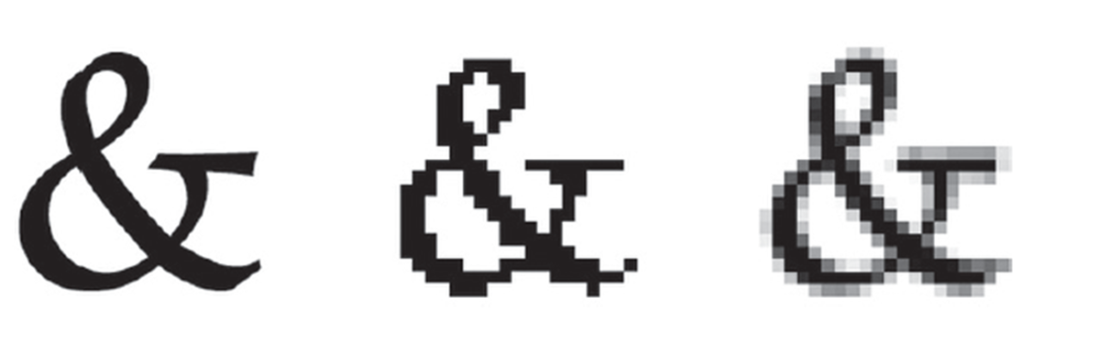
Compare a shape made with only black-and-white dots with one made using shades of gray; the latter shows how edge marks can make a filled boundary appear smoother. section 1.3
