Filtering transforms an image by sliding a kernel across pixel neighborhoods. Multiplying pixels by kernel weights and summing them produces each output intensity through convolution. section 3.1.4
Use different kernels for different image-processing goals:
- Average neighboring pixels with a normalized 5×5 blur kernel. section 3.1.4
- Generate a Gaussian kernel for image denoising, concentrating greater weight near the center. section 3.1.4
- Apply 2D convolution independently to each color channel, clip values to 0–1, and stack the channels. section 3.1.4
- Sharpen a blurred image with a kernel containing a strong positive center and negative surrounding weights. section 3.1.4
Denoising and sharpening
Apply a Gaussian kernel to a noised image to reduce noise, then apply a sharpening kernel to recover detail. Comparing the original, noised, blurred, and sharpened versions makes the tradeoff visible. section 3.1.4
An FIR filter is implemented by convolution (image from the book Deep Learning for Vision Systems by Mohamed Elgendy; Manning, 2020).
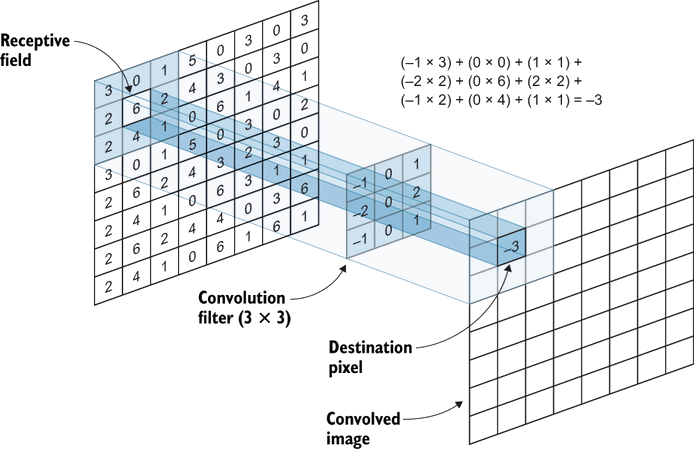
Follow the convolution diagram to see how an FIR kernel converts a local pixel window into one output pixel. section 3.1.4
