Filtering estimates a hidden, changing state from observations that arrive over time. It separates how the state evolves from how measurements reveal it, then repeatedly predicts and corrects the estimate. section 9.15 section 9.3
Each filtering cycle has two steps:
- Predict the next state using the current filtered belief and the state transition model, before seeing the next observation. section 9.3
- Update the prediction with the new observation through the observation model, producing a revised belief about the current state. section 9.3
Tracking atmospheric CO₂
A state-space model can represent the true CO₂ concentration as latent, let it evolve year by year, and connect it to noisy measurements. Filtering predicts the next concentration and corrects that prediction when the next measurement arrives. section 9.3
Figure 9.4 The diagram of a filter algorithm, which alternates between the prediction step and the update step to recursively generate predictions for a time series.
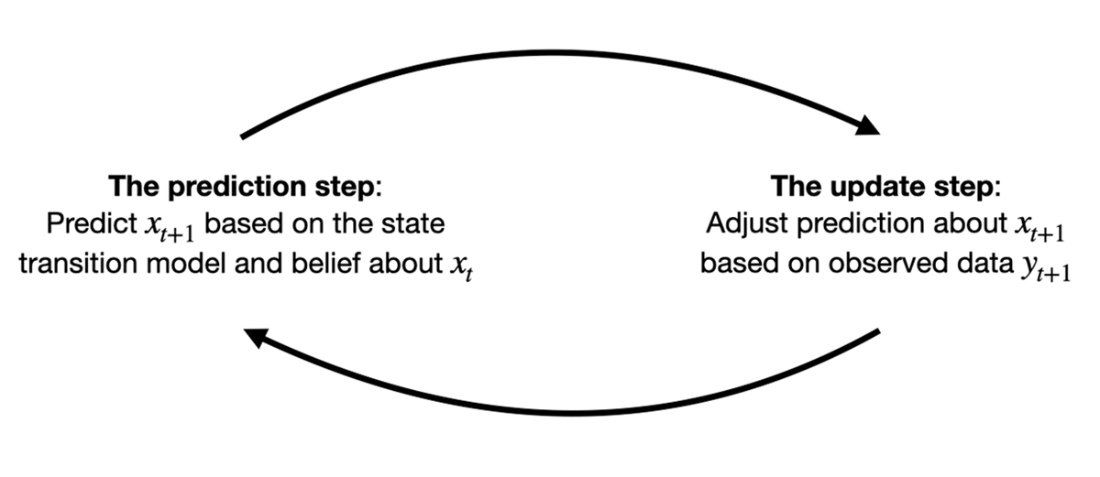
Follow the prediction-and-update cycle visually as it generates successive time-series estimates. section 9.3
