liveBook · Manning

Fire-and-forget operation

As explained in Spring in Action, Sixth Edition

The fire-and-forget model is a communication pattern in which a client sends a request without receiving a response from the server.

A fire-and-forget operation sends data to a server without expecting a response. It suits notifications or commands where continuing immediately matters more than handling confirmation. section 14.1

Sending a red alert

A ship-wide red alert illustrates the pattern: the alert is issued, and attention moves to the crisis instead of waiting for an acknowledgment. An RSocket server can accept an Alert payload on the "alert" route, log its level, sender, and timestamp, and return Mono<Void>. The client calls send() rather than retrieveMono() or retrieveFlux(), then subscribes. section 14.2.3
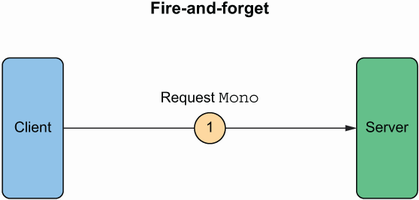
Figure 14.3 RSocket’s fire-and-forget communication model

Use the communication diagram to distinguish fire-and-forget from request-response, request-stream, and channel interactions. section 14.1


How Spring in Action, Sixth Edition covers it

How deep it goes
Explains the interaction model and demonstrates a reactive server handler and client call, without detailing delivery guarantees.
Examples
Uses a starship red alert, an Alert payload, an alert route, and logging as concrete examples.
What it assumes
Assumes basic familiarity with client-server communication and Reactor Mono, while contrasting the pattern with other RSocket models.
What you can do after
Apply it via Spring RSocket by mapping a Mono<Void> handler and calling send() without retrieving a response.
How it connects
Connects fire-and-forget with RSocket, reactive types, request-response, request-stream, channel, and Spring controllers.

Also explained in

Compare how 2 books explain fire-and-forget operation →

Related concepts

This explainer was generated by Manning's knowledge graph from the text of Spring in Action, Sixth Edition. The section links point to the parts of the book it draws on.