liveBook · Manning

Fixed ratio

As explained in Machine Learning System Design

A split-update procedure that preserves the ratio of training data to validation data as new labeled data arrives.

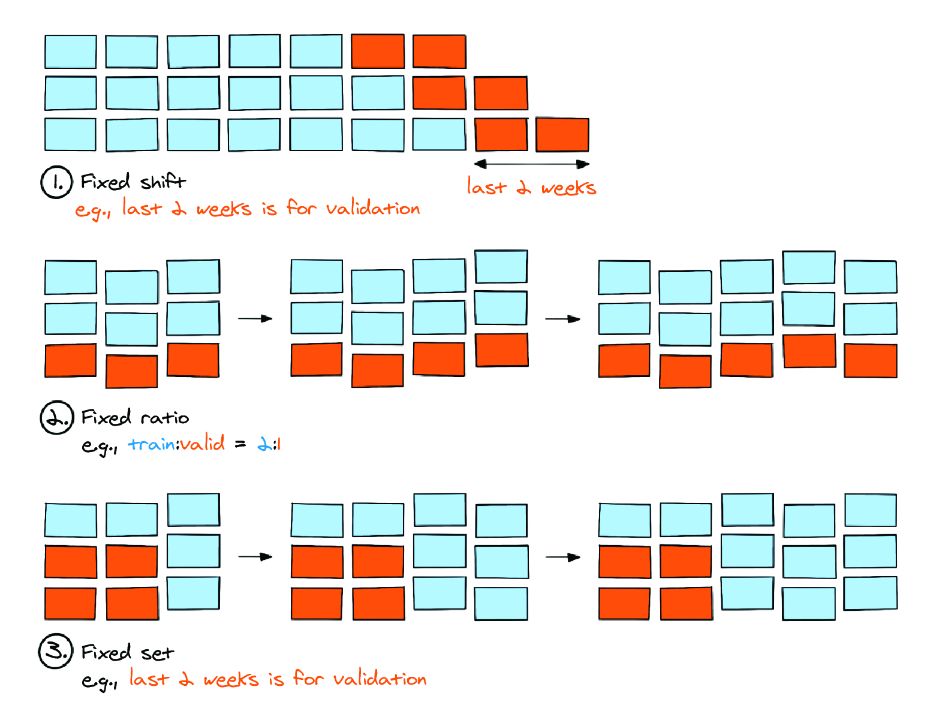
When labeled images or text arrive irregularly and older examples remain relevant, split each newly labeled portion so the training-to-validation ratio stays unchanged. section 7.4

Use the split to keep evaluation meaningful as the dataset grows:

  • Avoid placing new labels only in training, which can improve metrics simply because the model has more data. section 7.4
  • Avoid placing new labels only in validation, which can leave the model without exposure to newly appearing patterns. section 7.4
  • Split the added labels between both datasets using the existing proportion, then retrain and evaluate the model. section 7.4
Figure 7.7 Common options for updating train/validation sets. The light data blocks are used for training, while the dark ones are used for validation.
figure

Compare fixed-ratio updating with fixed-shift and fixed-set alternatives through the train/validation block patterns. section 7.4

How Machine Learning System Design covers it

How deep it goes
Explains the split rationale and procedure, but does not detail sampling algorithms or ratio calculations.
Examples
Uses newly labeled images or text and contrasts adding labels only to training, only to validation, or to both.
What it assumes
Assumes familiarity with training and validation datasets, while explaining why newly labeled data should enter both.
What you can do after
Apply fixed-ratio updating when expanding labeled datasets without making evaluation depend on which split receives new examples.
How it connects
Connects dataset updating with training data, validation data, model retraining, and fixed-shift and fixed-set validation.

Related concepts

This explainer was generated by Manning's knowledge graph from the text of Machine Learning System Design. The section links point to the parts of the book it draws on.