Imagine a row of numbered drawers: each drawer holds one value, and its number tells you where to find it. A fixed-size array works much the same way. It stores a collection of elements accessible by index, but you must choose the number of positions when you create it. That number stays fixed for the array’s lifetime. section 2.1 section 2.19
A static array typically holds elements of one type. Equal-sized elements can sit side by side in one block of memory, so the location of an indexed element is quick to determine. In Python-style zero-based indexing, an array of size n has valid positions from 0 through n−1; position n is out of bounds. section 2.3 section 2.4
Arrays implementation and memory addresses
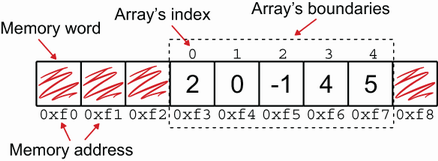
The memory-address diagram shows why equally sized elements can be reached directly by index. section 2.4
The fixed capacity shapes everyday operations:
- Choose capacity and element type at creation. You may assign initial values then; if you do not, check your language’s rules before reading an element. section 2.5
- Read or write a position by its index without visiting earlier elements. To find an element when you do not know its index, traverse the array. section 5.19 section 2.19
- If order does not matter and space is available, adding or removing an element can be straightforward. Once the array is full, storing more requires a new, larger array and copying elements into it. section 2.19 section 5.2
A calendar with numbered positions
An array can hold values for 24 days. With zero-based indexes, the value for day 1 sits at index 0, and day 24 sits at index 23. The known number of days makes fixed capacity convenient; the offset is worth remembering. section 2.3 section 2.8
Pick a fixed-size array when the required capacity is known or stable. Reserving far more positions than you usually need wastes memory; reserving too few forces a costly replacement. A dynamic array manages that replacement for you, using fixed-size arrays underneath. Fixed capacity can also suit a stack or a queue whose maximum size is predetermined. section 5.2 section 5.3 section 8.6 section 9.9
In Python, a list can resize, and array.array is typed but still dynamic. To experiment with fixed-size behavior, use a custom Array simulator; NumPy also offers fixed-size arrays. Do not assume an uninitialized position has a particular value without checking the language’s rules. section 2.7 section 2.5
