A flat namespace addresses objects directly through unique keys rather than nested directories. This structure scales across very large object collections and avoids directory-depth limits, while keys can still resemble familiar paths. section 5.2.2
Figure 5.6 Files are stored as blobs (binary large objects) alongside an object that holds the metadata and ID used to access them. A user requests a file by key, and the system uses the metadata to locate and retrieve it.
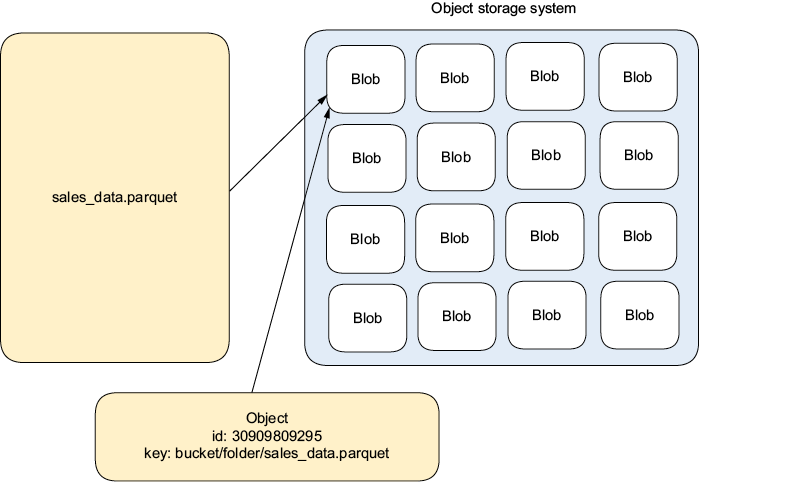
Shows how object data, metadata, and identifiers work together when a client requests an object by key. section 5.2.2
A flat namespace supports object-storage architectures by:
- Addressing each object independently through an S3-compatible API, enabling concurrent retrieval without directory locking. section 5.3.2
- Using metadata for search, lifecycle management, access control, versioning, and replication without changing object contents. section 5.2.2
- Supporting lakehouse tables composed of independently readable and writable immutable data and metadata files. section 5.3.2
Path-like keys
A key such as logs/2024/01/file.parquet resembles a directory path, but the object store treats it as one directly addressable key rather than a nested filesystem location. section 5.2.2

