FlatBuffers is a binary serialization format that transports data in an in-memory representation, allowing structured values to be used without first unpacking them into an intermediate object representation. This avoids much of the CPU and latency cost associated with serialization and deserialization. section 7.3
FlatBuffers uses little-endian byte order. Big-endian systems can use it after converting byte order, but that conversion adds CPU cost. Its main trade-off against Protocol Buffers is space: FlatBuffers stores values at their in-memory lengths, whereas Protocol Buffers can use variable-length encoding. section 7.3
Figure 7.2 Serialization transforms the in-memory representation of data (shown on the left as a Rust struct) to a serialized format such as JSON (shown on the right). Deserialization performs the opposite transformation from a serialized format to an in-memory representation.
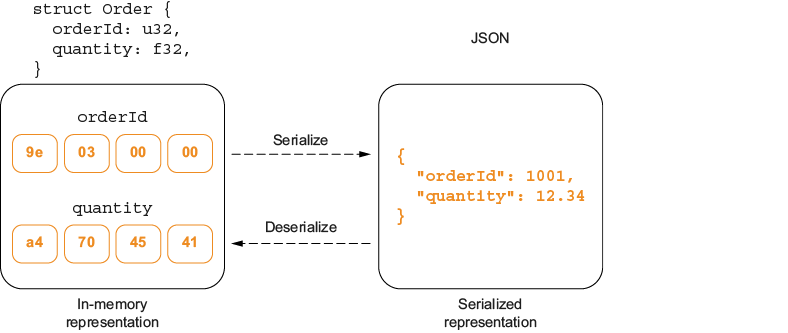
This figure contrasts an in-memory Rust struct with JSON and shows serialization and deserialization as opposite representation changes. section 7.3
