The forget gate is the LSTM component that decides how much of the previous cell state to retain. It combines the current input with the previous hidden state and produces values between 0 and 1: values near 0 discard memory, while values near 1 preserve it. section 4.2
This gate operates on the cell-state conveyor belt, distinct from the hidden state, which changes more actively with each input. Pointwise scaling lets different memory dimensions be forgotten or retained independently rather than applying one uniform decision. section 4.2
Selective memory retention
If a forget-gate value is close to 0 for one component, that component's previous cell-state information is mostly erased; a value near 1 carries it forward. section 4.2
Figure 4.2 A single LSTM cell. The inputs are the current vector Xt, the previous hidden state ht–1, and the previous cell state Ct–1. There are three learned gates: the forget ft, input it, and output Ot. They are all produced by sigmoid layers (“σ” blocks). A tanh layer forms a candidate update \(\tilde{C}\)t. Pointwise multiplications (“×”) and an addition (“+”) update the cell state on the top “conveyor” pathway. Arrows indicate vector flow; the legend marks pointwise operations, concatenation, and copies. This is the standard LSTM, emphasizing how gating enables selective memory retention and exposure. Used with permission granted by the author (Chris Olah), though it is slightly modified from its original form.
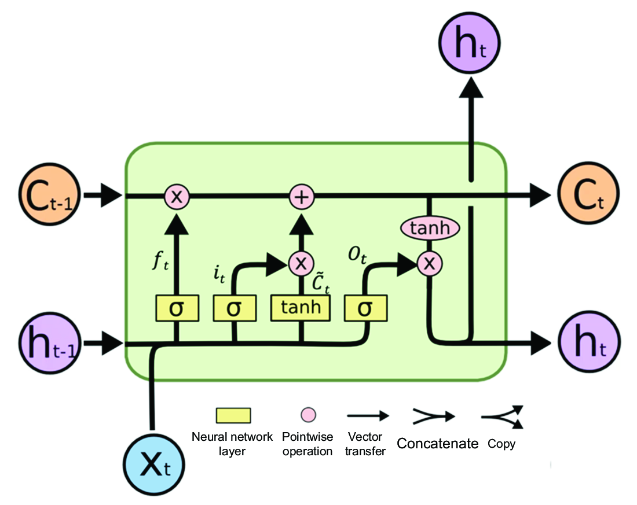
A standard LSTM-cell diagram shows the forget, input, and output gates, their sigmoid layers, and the pointwise operations that update the cell-state pathway. section 4.2
