liveBook · Manning

Formal verification

As explained in Real-World Cryptography

Formal verification is the use of mathematically based languages, models, and procedures to analyze whether a system satisfies specified properties.

When a cryptographic protocol assembled from familiar pieces develops a subtle edge-case attack, formal verification turns investigation into a computer-assisted analysis. You describe the protocol in an intermediate language and test whether it satisfies chosen properties. section 16.2 section 16.8

A practical formal-verification workflow includes:

  • Translate the protocol into the tool’s formal language and concepts. section 16.2
  • State what should be proved and express those properties formally. section 16.2
  • Inspect the result carefully: a formally checked proof can still prove the wrong thing. section 16.2
Figure 16.1 The Tamarin protocol prover is a free formal verification tool that you can use to model a cryptographic protocol and find attacks on it.
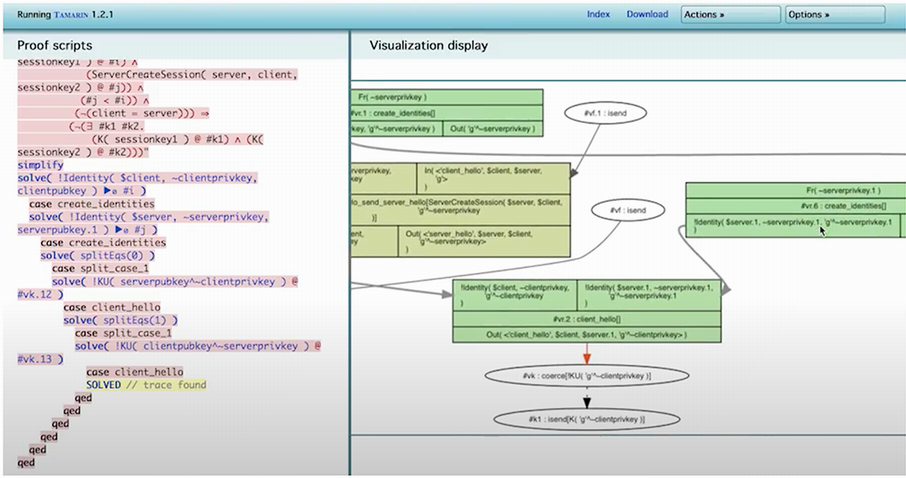
Tamarin models cryptographic protocols and searches for attacks, providing a concrete entry point for computer-assisted protocol analysis. section 16.2


How Real-World Cryptography covers it

How deep it goes
Explains protocol translation, property expression, and false proof goals, but does not descend into formal-language syntax or proof internals.
Examples
Uses Tamarin to model protocols and find attacks, and mentions Verifpal as an easier tool with a soundness tradeoff.
What it assumes
Requires understanding how to translate a protocol and its desired properties into the concepts and language of a verification tool.
What you can do after
Diagnose/debug with Tamarin by modeling a cryptographic protocol and checking stated properties for attacks.
How it connects
Connects formal verification with cryptographic protocols, cryptographic primitives, protocol attacks, and pen-and-paper proofs.

Also explained in

Compare how 2 books explain formal verification →

This explainer was generated by Manning's knowledge graph from the text of Real-World Cryptography. The section links point to the parts of the book it draws on.