A forward index maps each document and field to the terms contained in that document. It is the document-oriented counterpart to an inverted index, which maps terms to documents. section 5.4.3
In a search engine, the structure supports several operations:
- Faceting or aggregations, which show the top field values across a result set. section 5.4.3
- Real-time traversal and ranking of semantic relationships in a document collection. section 5.4.3
- Index-time generation through doc values in Lucene-based systems; Solr can also uninvert the inverted index in memory at query time. section 5.4.3
Document fields and terms
Suppose three documents contain job_title, desc, and skills fields. The forward index records the terms belonging to each document within each field, while the inverted index supports lookup from a field term to its matching documents. section 5.4.3
Figure 5.4 Inverted index and forward index. Documents get added to an inverted index, which maps documents to lists of terms, and to a forward index, which maps terms back to lists of documents. Having the ability to map both directions will prove important for graph traversal and relationship discovery.
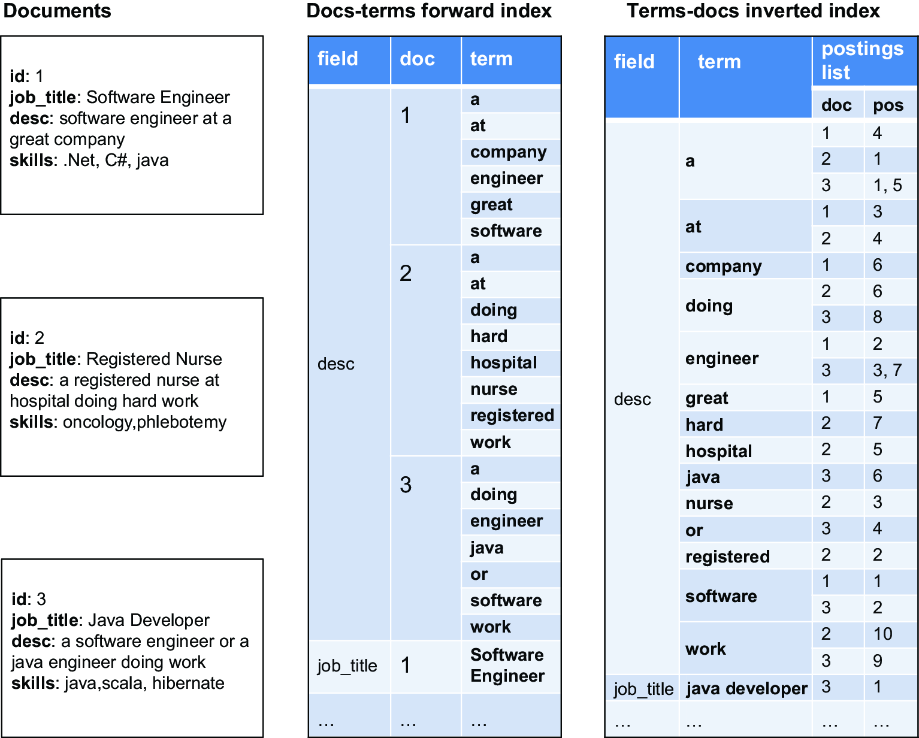
Compare the two index directions visually before relating them to graph traversal and relationship discovery. section 5.4.3

