Imagine an attacker stealing a current message key after recording an old conversation. Forward secrecy means that compromise does not unlock those earlier messages, provided their cleartext is no longer available. section 10.3.1 section 10.4.3
A message-level protocol builds this protection in stages:
- Start with a shared session secret, such as the output of X3DH, rather than using one permanent key for every message. section 10.4.3
- Derive separate sending and receiving chains with a key derivation function (KDF). section 10.4.3
- Pass each chain key through a one-way function to produce the next chain key and the individual message key. section 10.4.3
- Erase or stop relying on earlier keys so that compromising a current sending or receiving key does not recover previous ones. section 10.4.3
PGP’s missing safety net
PGP encrypts earlier emails under a long-lived private key. If that private key is later compromised, recorded emails encrypted under it can be decrypted. Changing the key can restore forward secrecy, but the process is inconvenient, so it is not enabled by default. section 10.3.1
Figure 10.15 Building on figure 10.14, forward secrecy can be introduced in the post-X3DH protocol by ratcheting (passing into a KDF) a chain key every time one needs to send a message, and ratcheting another chain key every time one receives a message. Thus, the compromise of a sending or receiving chain key does not allow an attacker to recover previous ones.
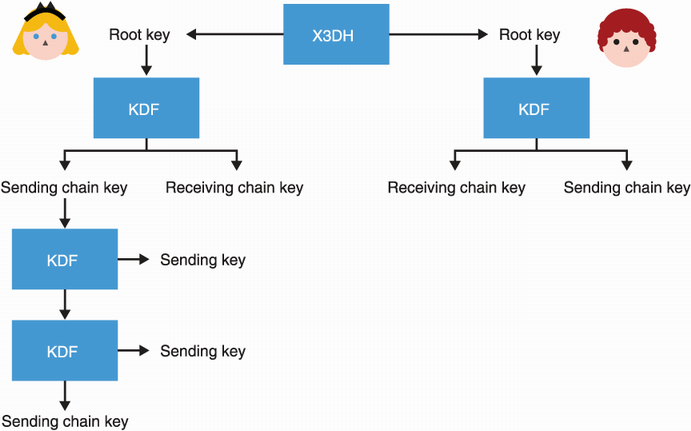
The ratcheting diagram shows how advancing a sending or receiving chain through a KDF prevents a compromised chain key from revealing earlier keys. section 10.4.3

