The foundation layer is the base of a React application stack: build tools, bundlers, TypeScript, and related technologies that shape how the application is developed and delivered. It commonly contains several technologies rather than one prescribed tool. section 1.5.2
Figure 1.6 The overall layers of a React application, with several examples of each. Note the dashed lines around the top two layers, which are the most likely ones to be left out.
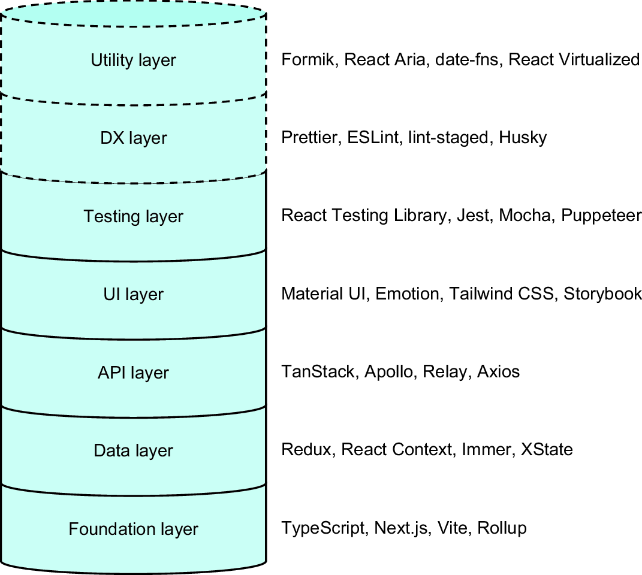
Use the layer diagram to place foundation technologies beneath the data, API, UI, and testing layers, while recognizing that stack descriptions can omit detail. section 1.5.2
Treat foundation selection as an architectural decision:
- Choose it early because changing the foundation later is harder than extending it with technologies that address specific pain points. section 1.5.4
- Balance team familiarity against ecosystem progress: familiar tools can increase delivery speed, while newer tools may be simpler, faster, or better maintained. section 1.5.4
- Revisit the decision throughout a project, including when an aging technology must be replaced despite migration and learning costs. section 1.5.4
Medium-size e-commerce platform
A platform modernization targeting performance, scalability, and user experience favors a proven foundation that supports moving quickly and building efficiently. The resulting stack should reflect the project’s constraints rather than an abstract ranking of technologies. section 1.5.4
