A frame is a Layer 2 protocol data unit (L2PDU): a packet combined with a Layer 2 header and trailer. Its payload is the packet inside it. Frames provide hop-to-hop delivery, while switches use Layer 2 information to forward them within a LAN. section 4.3.2 section 6.0
Track a message through encapsulation and delivery:
- Application data receives a Layer 4 header and becomes a segment; the segment receives a Layer 3 header and becomes a packet. section 4.3.2
- The packet receives a Layer 2 header and trailer and becomes a frame before transmission over the physical medium. section 4.3.2
- A switch forwards known unicast frames and floods broadcast or unknown unicast frames without modifying them. section 10.3
- A router removes the received frame, examines the packet, and creates a new frame addressed to the next hop. section 10.3
- The destination host inspects and removes the Layer 2 header and trailer before passing the packet to Layer 3. section 4.3.2
PC1 sends a ping to PC3
Because PC3 is on another LAN, PC1 uses ARP to learn its default gateway’s MAC address, then sends the packet to PC3 inside a frame addressed to that gateway. Each router forwards the unchanged Layer 3 destination packet in a new frame addressed to the next hop. At the final LAN, the last router creates a frame addressed to PC3. section 10.1.1 section 10.0
Figure 4.7 Application data encapsulated in a Layer 4 header is a segment (L4PDU); a segment encapsulated in a Layer 3 header is a packet (L3PDU); and a packet encapsulated in a Layer 2 header/trailer is a frame (L2PDU). The encapsulated contents of each PDU are that PDU’s payload.
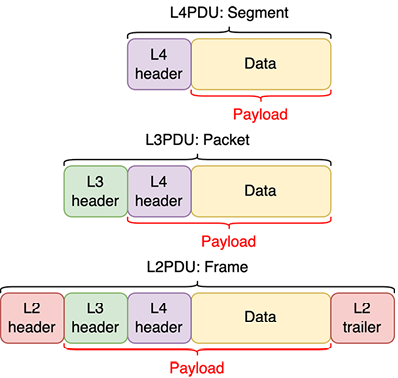
Trace the relationship among application data, segments, packets, and frames, including each PDU’s payload. section 4.3.2
