A bank reviewing a digital payment must decide whether to approve it, challenge the customer, or stop it. Fraud detection checks transactions and related activity for suspicious signals before losses grow. The goal is not simply to catch more fraud: unnecessary alerts consume review capacity, and blocking legitimate customers damages trust. section 1.3.1 section 7.5
This is an adversarial task. Fraud is usually rare, often representing less than 1% of transactions, while attackers adapt to defenses. Missed fraud creates losses; false alarms create friction. Patterns also change quickly, so a detector that works today needs continued monitoring. section 7.3
Figure 7.3 Core characteristics that distinguish financial fraud from other AI challenges. The central icon, a scroll representing a financial record ($) under scrutiny (eye), symbolizes the core challenge of identifying a fraudulent financial event. This task is uniquely difficult due to a set of interconnected factors: extreme class imbalance (Sparsity of events), the need for explainability, complex multisource data, organized and adaptive attackers, the rapid evolution of fraud tactics, and the high costs of both false negatives and false positives.
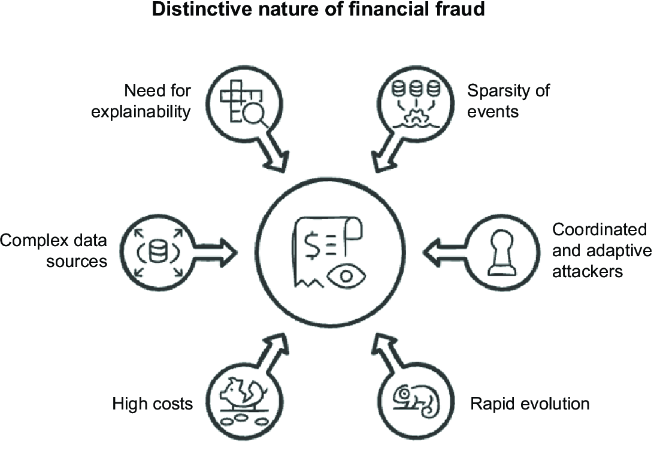
Use the diagram to check the six interacting design pressures: rare events, adaptive attackers, changing tactics, varied data, explainability, and costly errors. section 7.3
Build a detector as a four-layer workflow, not as an isolated model:
- Data asset: Assemble timely transaction details with account changes, login history, device fingerprints, session behavior, and network relationships. Fraud signals often lie in behavior and connections around a payment, not its amount alone. section 7.4.2
- Modeling: Use labeled history and supervised learning to recognize known patterns; use anomaly detection to flag unusual activity when prior fraud labels cannot describe a new threat. Graph analytics can examine connected entities and organized fraud. Choose methods against label availability, inference speed, resources, and explainability needs. section 7.4.3 section 7.5
- Strategy and monitoring: Convert scores into risk thresholds, business-rule decisions, watchlist checks, and human-review queues. Track performance and drift; use reviewer feedback and champion-challenger testing to adjust the strategy. section 7.5
- Application: Put decisions into payment and account workflows—approve, decline, or challenge a transaction; alert customers; and give analysts an enriched case for investigation. section 7.5
Score known fraud without hiding rare cases
For a labeled transaction dataset, train a LightGBM classifier in an imblearn pipeline incorporating SMOTE, tune it with RandomizedSearchCV, and evaluate it on an imbalanced test set. Do not rely on accuracy alone: inspect precision, recall, F1, and AUC-PR. Precision@TopN% and Fraud Capture Rate@TopN% connect ranked alerts to the number of cases analysts can review and the fraud those reviews might capture. Treat the resulting score as an input to a threshold and review workflow, not an automatic declaration of fraud. section 8.5 section 7.5
To look for previously unseen patterns, an autoencoder can learn from legitimate transactions and flag high reconstruction error as an anomaly. An unusual transaction still needs investigation: atypical legitimate behavior, such as travel, can otherwise become a false positive. Keep detection, customer experience, explainability, and regulatory obligations in view as tactics and data change. section 8.5 section 7.3
