A free coefficient is the constant term in a linear equation: a number that is not assigned to, or multiplied by, any variable. In standard form, it shifts the equation without changing the variable coefficients. section 3.1.2
Parallel lines differ by the free coefficient
Compare x₁ − 2x₂ = 0 with x₁ − 2x₂ + 2 = 0. Their variable coefficients match, but their free coefficients differ, so the equations describe parallel lines rather than one intersection. If the lines coincide instead, every point on that line satisfies both equations, producing infinitely many solutions. section 3.1.2
Free coefficients also participate directly in linear-system algorithms:
- Scale a row and its free coefficient by the same nonzero number. section 3.6.2
- Add one row and its free coefficient to another row and free coefficient. section 3.6.2
- Swap rows together with their respective free coefficients. section 3.6.2
- During Gaussian elimination, these operations transform the vector of free coefficients into the solution vector when the system is properly specified. section 3.6.2
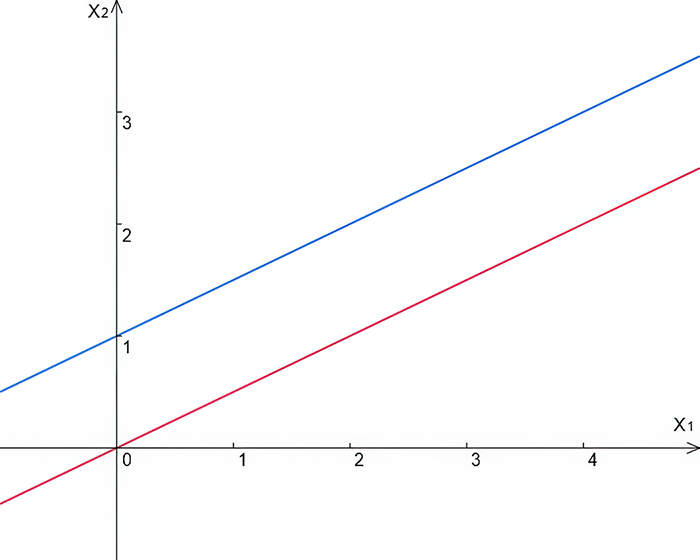
Use the geometry figure to see how matching variable coefficients and differing free coefficients create parallel hyperplanes with no common solution. section 3.1.2
