A human agent should not have to reread a two-minute automated conversation to understand why a user was transferred. A free-text summary gives a concise natural-language account of the essential events and outcome, alongside selected structured metadata. section 12.1.2
Claim-status handoff
After collecting and verifying tax ID, member ID, date of birth, name, and service date, the assistant finds claim #111222333. A useful summary might state: “Verified member #87654321 and provider #123456789; claim for February 1, 2024 was paid May 23, 2024 for $201.83.” The agent receives the essential result without rereading every question and answer. section 12.1.2
Keep the summary useful by:
- Including enough information to understand the complete conversation and its outcome. section 12.1.2
- Selecting only details the receiving agent needs; store important identifiers such as provider ID, member ID, and claim ID. section 12.1.2
- Pairing the prose with metadata such as user identifiers, collected identifiers, session count, or sentiment when relevant. section 12.1.2
Figure 12.2 An effective summary pulls out key details from the conversation. Here it includes a summary of the conversation and the last claim searched. The AI portion of the call may have taken two minutes, but the human agent can read the summary in seconds.
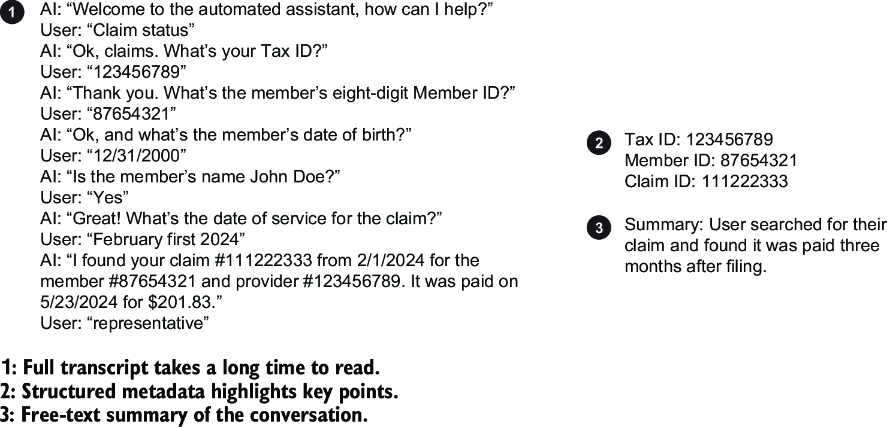
Use the effective-summary example to compare the conversation’s duration with the agent’s reading time and identify the details worth surfacing. section 12.1.2
