A front-door estimand identifies the causal effect of a treatment on an outcome through an observed mediator. It separates causal influence from association when treatment and outcome may share unmeasured causes. section 10.5 section 10.5.2
Side-quests, won items, and purchases
Side-quest engagement (E) affects won items (W), and won items affect in-game purchases (I). Guild membership (G) also influences engagement and purchases, creating a backdoor relationship. The mediator W helps identify the effect of E on I without requiring adjustment for every common cause. section 10.5.1 section 10.5.2
Check these identification conditions before treating the estimand as usable:
- Require full mediation: the mediator intercepts every directed causal path from treatment to outcome. section 11.3.3
- Require first-stage unconfoundedness: no hidden confounder jointly affects treatment and mediator. section 11.3.3
- Require second-stage unconfoundedness: no hidden confounder jointly affects mediator and outcome after accounting for treatment. section 11.3.3
- Use the mediator to avoid backdoor adjustment when many confounders exist, latent confounders prevent adjustment, or unknown confounders remain plausible. section 10.5.2
Figure 10.11 Side-quest engagement leads to winning virtual items like this magic bow. Won items drive more in-game purchases, such as magic arrows for the magic bow, so we introduce a mediator “won items” on the causal path between side-quest engagement and in-game purchases.
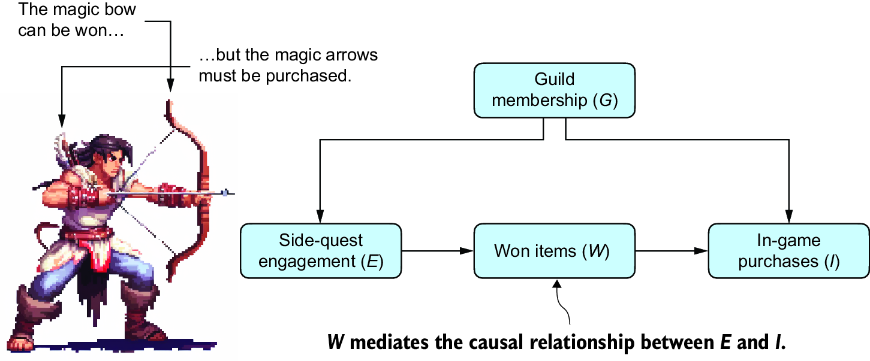
The causal diagram places won items between side-quest engagement and in-game purchases, making the mediation structure explicit. section 10.5.1
Identification in code
Represent the graph with directed edges G→E, G→I, E→W, and W→I; query P(I do(E=e)); and provide P(I,E,W) as the observational distribution. y0 can then derive the front-door estimand. DoWhy can identify it from a pandas DataFrame, a DAG, and the treatment and outcome names. section 11.3
Identification is distinct from estimation: once the front-door estimand exists, observed variables can support inference even when some model parameters are not identifiable. A fitted causal generative model estimates this identified quantity rather than removing bias by modeling alone. section 11.6.3 section 11.6.7
