A promise is fulfilled when its asynchronous operation completes successfully. It carries an associated value, and fulfillment is one of the two settled states; the other is rejection. section 8.1.1
Keep these state rules in mind:
- A promise starts pending, and its state and value become permanent once it is settled. section 8.1.1
- Calling resolve with an ordinary value fulfills the promise with that value; resolving with another promise adopts that promise’s outcome, which may be rejection instead. section 8.1.1
- A fulfilled promise can pass its value to a then callback; the callback’s return value determines the next promise’s resolution. section 8.1.2
Figure 8.1 The possible states of a promise: pending, fulfilled, rejected. The value associated with the rejected state is often called a reason.
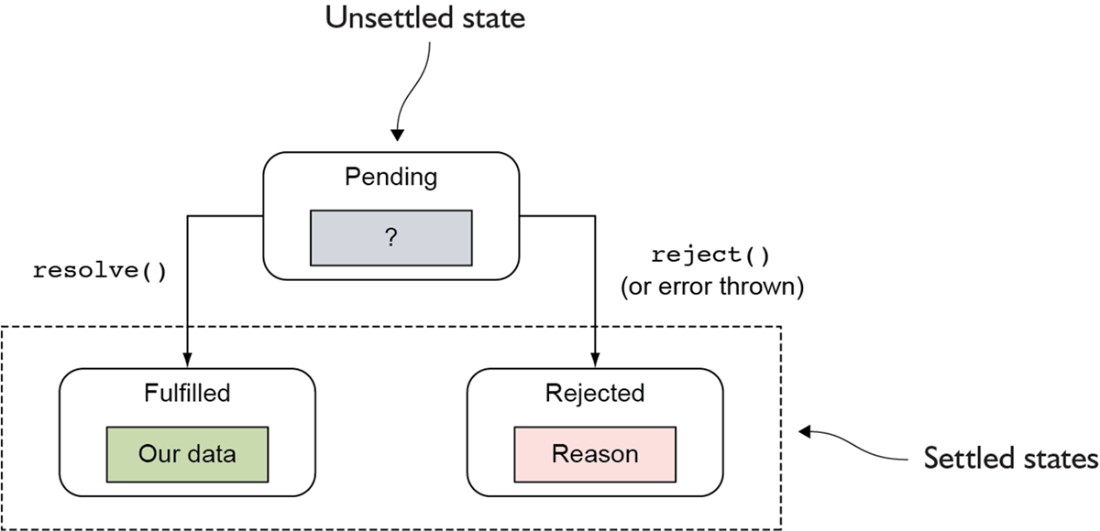
Use the state diagram to compare fulfillment with pending and rejection, and see that settled states carry values. section 8.1.1
Adopting another promise’s outcome
Resolving one promise with a fulfilled promise leads to fulfillment; resolving another with a rejected promise leads to rejection. Calling resolve does not guarantee that the resulting promise is fulfilled. section 8.1.1


