A full binary tree is a binary tree where every node has either no children or exactly two. A node with one child breaks the rule. Unlike a perfect binary tree, a full binary tree does not require all leaves to sit at the same depth. section 1.4.4
Figure 1.8 A comparison of common binary tree structural variations. Left: A standard binary tree where nodes have a maximum of two children. Middle: A full binary tree enforcing that nodes possess either exactly zero or exactly two child nodes. Right: A highly uniform perfect binary tree where all interior nodes contain two children and every leaf node aligns at the exact same depth level.
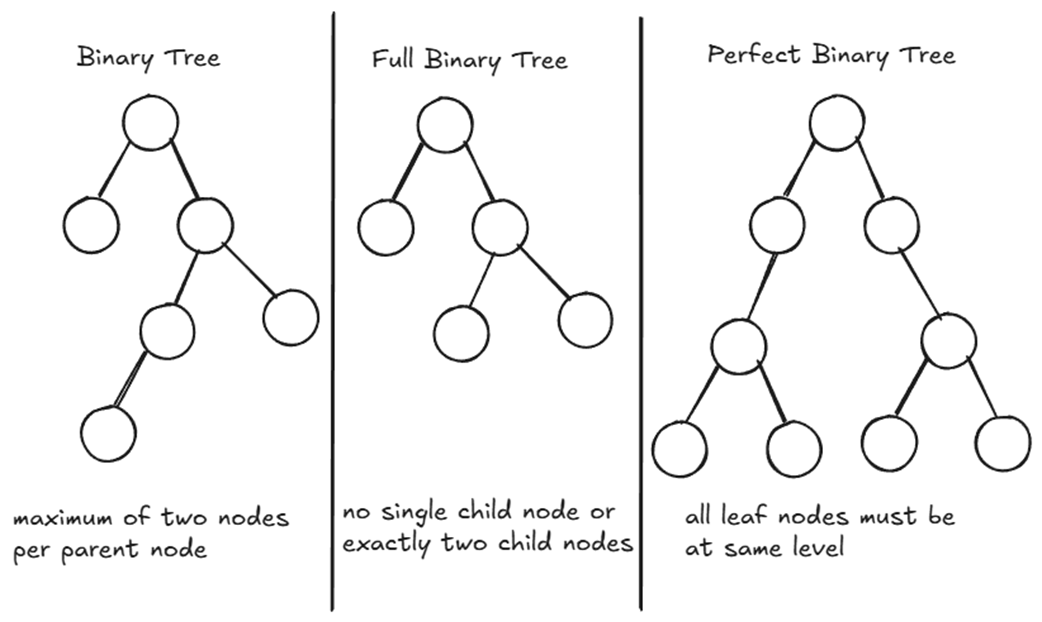
Compare a full binary tree with ordinary and perfect binary trees. section 1.4.4
A reporting hierarchy
Imagine each manager reporting to either no one or exactly two managers. Individual contributors with no direct reports are leaves; a manager with only one direct report would violate the full-tree rule. section 1.4.4
