A function class is a specified set of functions from which an assignment or prediction function may be selected. In a structural causal model (SCM), choosing the class is a central modeling decision because it states assumptions about how causes produce effects. section 6.4.1
Function classes constrain both causal modeling and SCM learning:
- They may consist of familiar mathematical forms such as linear functions, or executable rules containing conditionals, loops, and recursion. section 6.4.1
- They reduce the infinitely many assignment functions that could reproduce observed inputs and outputs, often alongside an Occam’s-razor or model-selection criterion. section 6.2.2
- A misspecified class can still support useful causal inference when it captures the behavior relevant to that inference; otherwise, the omitted relationship can matter. section 6.4.1
Modeling a nonlinear effect
Suppose the ground-truth relationship between X and Y follows a biochemical Hill equation, producing an S-curve. An SCM using a fitted logistic assignment function may differ from that ground truth yet remain adequate if it preserves the S-curve features required by the causal inference. Treating every assignment function as linear, without relying on that assumption, effectively reduces the SCM to a causal graphical model with linear causal kernels. section 6.4.1
Figure 6.16 Different SCMs can entail the same DAG structure and distributions. The SCMs can differ in assignment functions (and/or exogenous distributions).
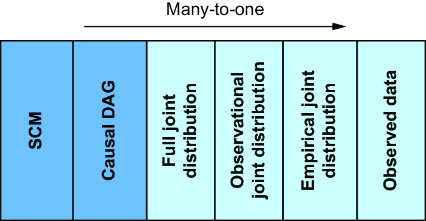
Compare SCMs that share a DAG and distributions but differ in assignment functions or exogenous distributions. section 6.2.2
