A functional role represents the privileges a person needs for a job function or business responsibility. In Snowflake RBAC, grant access roles to functional roles, then grant functional roles to users. Keep access roles focused on common privilege sets, while functional roles express who needs those sets: for example, data engineer or data analyst. section 10.1.3
Design functional roles around operational responsibility rather than individual objects:
- Start with job functions, then refine broad roles by business unit when their access needs differ, such as separate Bread and Pastry analyst roles. section 10.1.3 section 10.2
- Grant access roles such as full-access or read-only roles to functional roles; avoid granting access roles to other access roles. section 10.1.3
- Grant functional roles to other functional roles sparingly so the hierarchy remains maintainable. section 10.1.3
- Use managed access schemas and future grants so access-role privileges are governed centrally and extend to newly created objects. section 10.1.3
Figure 10.1 Role-based access control configuration of the environment used in the example in this chapter. The environment includes two functional roles, DATA_ENGINEER and DATA ANALYST, and two access roles, BAKERY_FULL and BAKERY_READ. Access roles are granted to functional roles, and functional roles are granted to the SYSADMIN role.
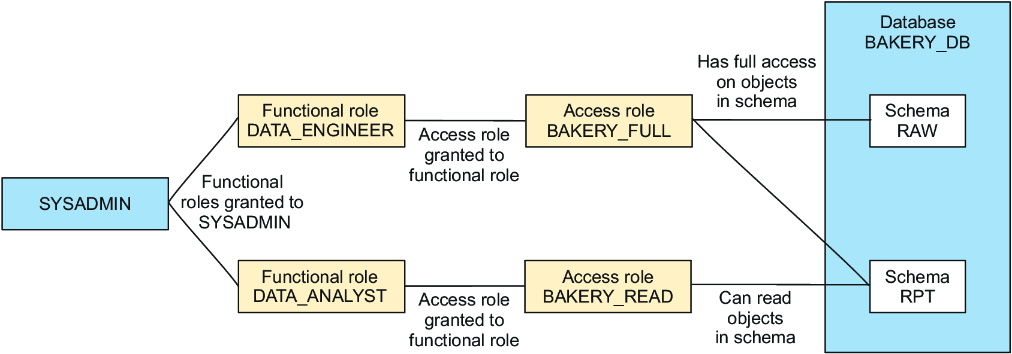
The role layout separates job-facing functional roles from privilege-bearing access roles: DATA_ENGINEER receives BAKERY_FULL, while DATA_ANALYST receives BAKERY_READ. section 10.1.3
Business-unit analyst roles with row filtering
DATA_ANALYST_BREAD and DATA_ANALYST_PASTRY can both inherit BAKERY_READ for the RPT schema. A row access policy then checks the active functional role and returns only Bread or Pastry employee rows, respectively. This combines shared object privileges with role-specific row visibility. section 10.2
Functional roles fit into a custom role hierarchy whose top custom role can be granted to SYSADMIN. Privileges remain assigned to roles rather than directly to users, allowing administrators to control permitted actions on securable objects through role assignment. section 10.4
