Functional, stateless design treats computation as the evaluation and composition of functions. It favors immutable bindings over destructive assignment, keeps shared mutable state to a minimum, and separates effects from ordinary calculations. The aim is not merely shorter code: it is simpler reasoning about correctness, determinism, parallelism, and future change. section 1.2.1 section 1.5.1
A mutable, step-by-step routine can replace old values, depend on hidden state, and produce different results under concurrency. A pure function instead derives its result only from its arguments and changes no state. Calling it again with the same inputs yields the same output; composing pure functions preserves that predictability. Effects may still be necessary, but should be explicit rather than mixed into calculations. section 1.5 section 1.5.1
Keep calculation separate from action
A calculation such as calc can add inputs, compute an average, and choose a maximum without interacting with the outside world. Printing the result belongs in an effectful routine. This split makes the calculation independently understandable and leaves the boundary with I/O visible. Hiding an action such as launchMissile inside max breaks the expectation created by an otherwise ordinary numeric function. section 1.5.1
Figure 1.12 Pure pyramidal functional code
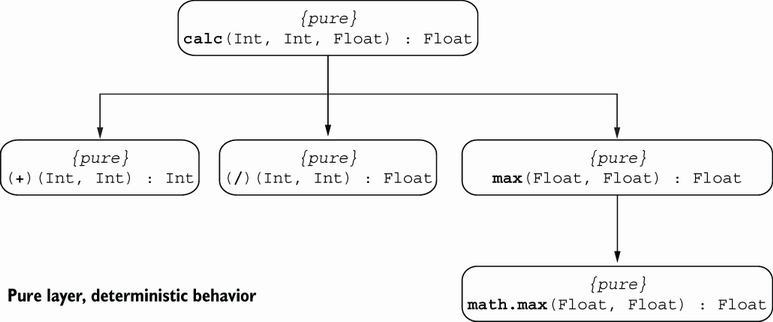
This evaluation-flow diagram shows a pure calculation assembled as a pyramid of smaller functions, with arguments flowing to a predictable result. section 1.5.1
The philosophy also guides domain design. Look for stable properties of the domain, express them as types and functional idioms, then reuse the operations those idioms provide. A list of names can be mapped to name lengths while preserving list structure; nested optional names can be mapped without discarding missing values. Such invariants make correct behavior a consequence of the representation and its operations. section 1.3.3
Functional interfaces can decouple subsystems without relying on object-oriented interfaces:
- Represent an operation set as an algebraic data type and supply an interpreter. section 1.3.3
- Encode a boundary as a state machine, monadic interface, or type-class-based abstraction. section 1.3.3
- Choose designs consciously: functional code can still be overly complex or tightly coupled. section 1.6 section 13.2.7
Immutability and purity improve testability because deterministic code can be evaluated in a test environment with predictable behavior. They help with refactoring, concurrency, and isolating functionality, but they do not remove every risk or replace testing and design judgment. Functional techniques are tools whose trade-offs—including boilerplate, convenience, and advanced language features—still matter. section 15.1 section 13.2.7


















