Game ROM is read-only cartridge memory. PRG ROM holds executable game code, while separate ROM can hold the tile patterns used for backgrounds and sprites. section 1.5.2 section 16.2.1
On the NES, PRG ROM participates in several practical limits and techniques:
- Early games commonly provided 16K or 32K of ROM for game code, alongside 8K for graphical patterns. section 16.2.1
- The NES can access only 64K of memory at once, so larger games swap memory banks into that address space. section 16.2.1
- A mapper selects which PRG ROM bank is active when the program writes to designated cartridge memory locations. section 16.2.1
Figure 16.1 Standard NES cartridge memory layout
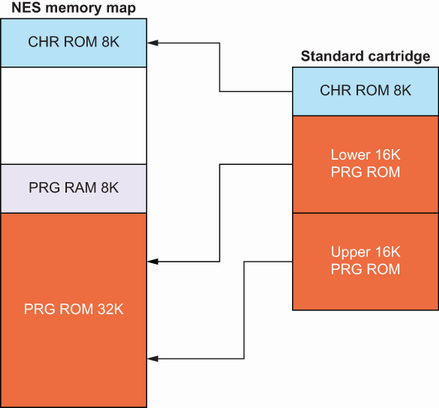
Use the standard cartridge memory layout to distinguish PRG ROM for code from CHR ROM for graphical patterns. section 16.2.1
Figure 16.2 Example of expanded NES cartridge memory layout
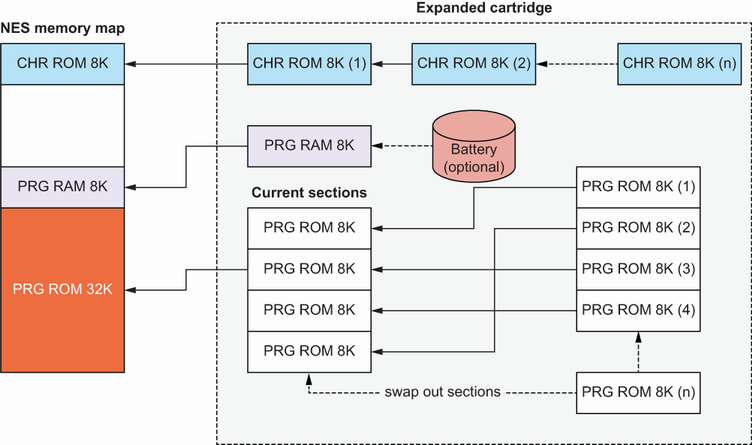
Compare an expanded cartridge layout to see how mapper hardware makes additional code and pattern storage available. section 16.2.1
Expanded cartridges can support much larger and more complex games. Custom logic may also add sound channels or nonvolatile storage for saved progress. section 16.5