liveBook · Manning

Gaussian curvature

As explained in Geometry for Programmers

Gaussian curvature is the product of the two principal curvatures at a surface point.

When a surface is not locally sphere-like, measure its curvature by slicing it with planes through the surface normal. Each slice produces a curve with its own curvature. The smallest and largest signed values are the principal curvatures; their product is the Gaussian curvature. This gives a pointwise description of how a surface bends, rather than forcing every surface to resemble a sphere. section 5.2.3

Sphere, plane, and cylinder

A sphere has constant Gaussian curvature. A plane has Gaussian curvature zero everywhere. A cylinder also has Gaussian curvature zero: one principal curvature is zero even though its mean curvature is nonzero. section 5.2.3
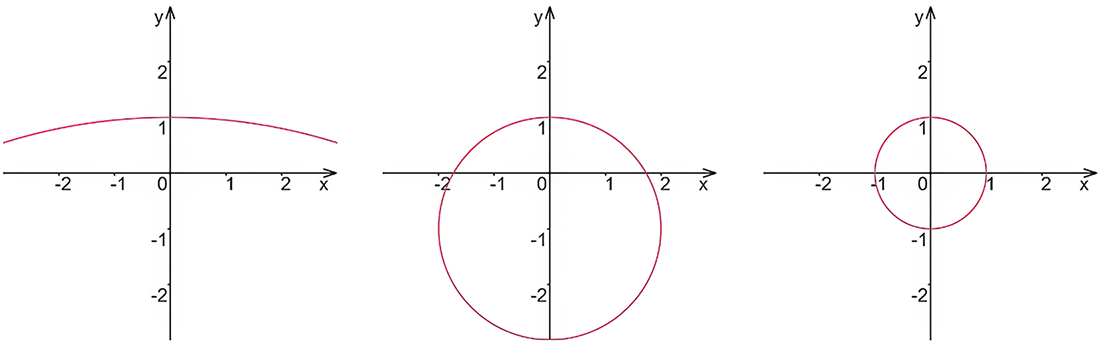
Figure 5.16 The smaller the radius, the larger the curvature.
05-16

Use the radius-curvature figure to build intuition for the circle curvatures underlying principal-curvature measurements. section 5.2.3

How Geometry for Programmers covers it

How deep it goes
Defines Gaussian curvature as the product of principal curvatures and compares spheres, planes, and cylinders.
Examples
Uses spheres, planes, cylinders, normal-plane slices, and fitting circles as geometric examples.
What you can do after
Evaluate/understand whether a surface has spherical, flat, or saddle-like bending through principal-curvature products.
How it connects
Connects principal curvature, mean curvature, principal planes, surface curvature, and signed curvature.

Related concepts

This explainer was generated by Manning's knowledge graph from the text of Geometry for Programmers. The section links point to the parts of the book it draws on.