liveBook · Manning

Gaussian noise

As explained in Grokking AI Algorithms, Second Edition

Gaussian noise is random variation whose values follow a Gaussian probability distribution.

Gaussian noise is random variation drawn from a bell-shaped probability distribution. Values usually cluster around 0, while increasingly extreme values become less likely. section 12.9

In diffusion models, Gaussian noise supports a learnable noising-and-denoising process:

  • Sample random noise from a standard normal distribution. section 12.9
  • Mix the noise with a clean image using weights controlled by a noise schedule. section 12.9
  • Train the model to recognize the added pattern so it can remove noise during reverse diffusion. section 12.9

Noising an image step by step

For each timestep, sample a random noise array, calculate the square-root weights from alpha-bar, and combine the clean image with the noise. Repeating this process produces progressively noisier images while preserving the exact noise pattern for training. section 12.9

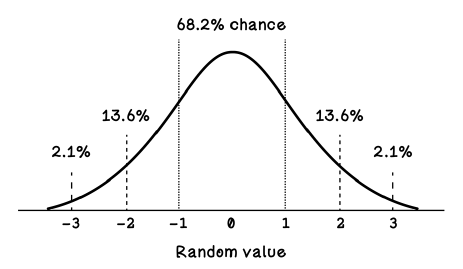
Figure 12.16 A view of probability of selection in a normal distribution
12_16

Use the normal-distribution figure to see why values near zero are selected more often than extreme values. section 12.9


How Grokking AI Algorithms, Second Edition covers it

How deep it goes
Defines standard-normal sampling, explains its probability pattern, and implements progressive image noising with stored noise patterns.
Examples
Demonstrates Gaussian noise through progressively noisier images, probability-distribution visualization, and Python diffusion code.
What you can do after
Apply it via a forward-diffusion implementation that samples, scales, mixes, and records noise for model training.
How it connects
Connects Gaussian noise with normal distributions, forward diffusion, reverse diffusion, noise schedules, and diffusion models.

Also explained in

Compare how 3 books explain Gaussian noise →

Related concepts

This explainer was generated by Manning's knowledge graph from the text of Grokking AI Algorithms, Second Edition. The section links point to the parts of the book it draws on.