liveBook · Manning

Gene

As explained in Optimization Algorithms: AI techniques for design, planning, and control problems

A gene is a segment of genetic material that encodes a specific biological property or functional product.

A gene is a section of genetic material that codes for a specific property or functional product. Genes occur on chromosomes made of DNA; alternative forms are alleles, each gene occupies a locus, and an organism’s complete gene combination forms its genotype. section 7.2.1

Toy organism

A DNA molecule can contain four genes describing appetite, movement, feet, and skin. Their alleles might specify herbivore, flying, wings, and feathers. Together, these alleles form a genotype whose observable traits form the phenotype through interaction with the environment. section 7.2.1

In a genetic algorithm, genes represent parameters of a candidate solution. Concatenating those genes creates a chromosome, so choosing an encoding—binary, real-valued, or permutation—directly affects search performance. For a ticket-price solution, an 8-bit chromosome encodes prices from 75.0 to 235.0 at 0.1 precision. section 7.3.2

Figure 7.4 Genotype, phenotype, and taxonomic classification
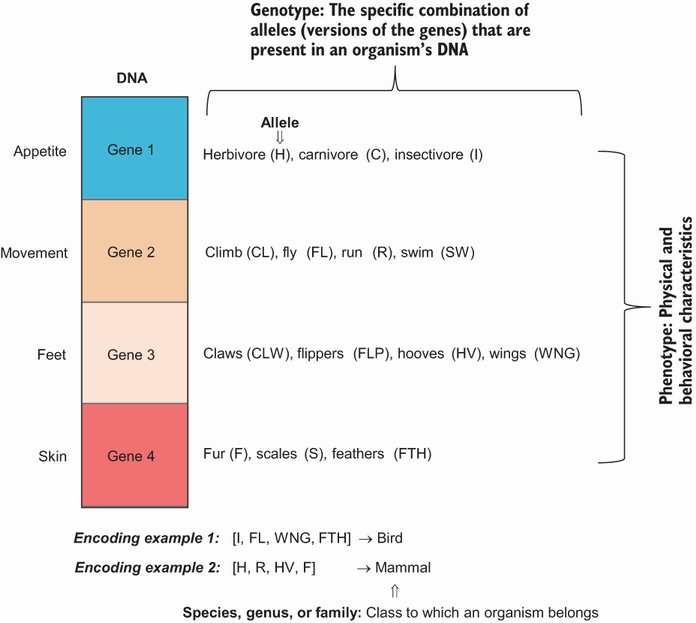
Use the genotype–phenotype figure to connect gene combinations with observable characteristics and biological classification. section 7.2.1


How Optimization Algorithms: AI techniques for design, planning, and control problems covers it

How deep it goes
Explains genes through alleles, loci, genotypes, phenotypes, and encoding, stopping short of molecular mechanisms.
Examples
Illustrates genes with appetite, movement, feet, and skin traits, then applies them to binary ticket-price chromosomes.
What you can do after
Evaluate/understand how biological genes map to genetic-algorithm parameters and chromosomes with suitable encodings.
How it connects
Connects genes to DNA, chromosomes, alleles, loci, genotypes, phenotypes, chromosomes, encodings, and genetic algorithms.

Also explained in

Compare how 5 books explain gene →

Related concepts

This explainer was generated by Manning's knowledge graph from the text of Optimization Algorithms: AI techniques for design, planning, and control problems. The section links point to the parts of the book it draws on.


