liveBook · Manning

General-purpose zero-knowledge proof

As explained in Real-World Cryptography

A zero-knowledge proof system capable of proving the correct execution of general computations or programs, potentially while hiding selected inputs or outputs.

A general-purpose zero-knowledge proof lets a prover convince a verifier that a program executed correctly while hiding selected inputs or outputs. Unlike proofs limited to discrete logarithms, it can cover general computations. section 15.3

Typical uses include:

  • Proving that a computation or execution trace is correct without revealing every value involved. section 15.3
  • Supporting confidentiality, compression, and identity claims such as proving age without revealing it. section 15.3
  • Enabling privacy and space-saving techniques, especially in cryptocurrency systems. section 15.3
Figure 15.11 General-purpose ZKPs allow a prover to convince a verifier about the integrity of an execution trace (the inputs of a program and the outputs obtained after its execution) while hiding some of the inputs or outputs involved in the computation. An example of this is a prover trying to prove that a sudoku can be solved.
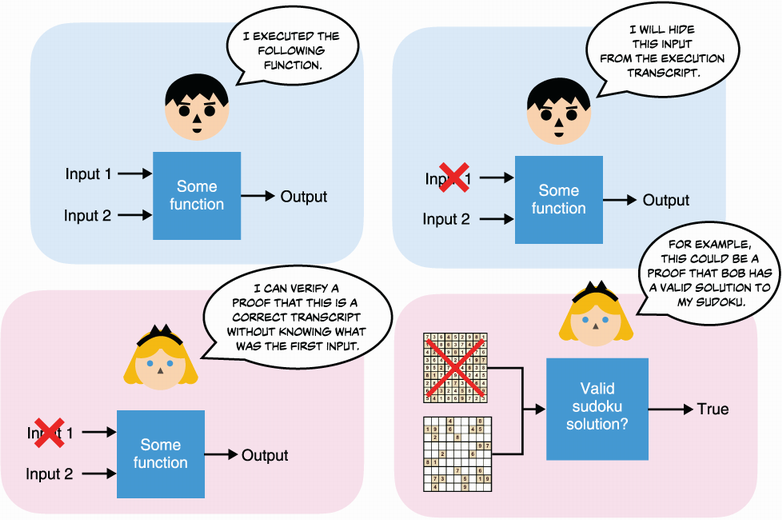
A prover demonstrates that a Sudoku can be solved by proving the integrity of its execution trace while hiding some inputs or outputs. section 15.3

How Real-World Cryptography covers it

How deep it goes
Defines the capability and motivation, but stops short of explaining modern schemes or implementation mechanics.
Examples
Uses Sudoku, hidden program inputs or outputs, and proving age without revealing identity details.
What it assumes
Builds from familiarity with zero-knowledge proofs, signatures, and discrete logarithms.
What you can do after
Evaluate applications of general-purpose proofs across privacy, compression, identity, and cryptocurrency scenarios.
How it connects
Connects zero-knowledge proofs with signatures, discrete logarithms, execution traces, cryptocurrencies, and standardization.

Related concepts

This explainer was generated by Manning's knowledge graph from the text of Real-World Cryptography. The section links point to the parts of the book it draws on.