A generative interface dynamically adapts content, visual design, and functionality to a user’s needs and context, extending personalization beyond tailored content. section 10.0
It belongs to a fluid family of conversational, graphical, hybrid, and generative interfaces rather than a rigid taxonomy. Products can combine several patterns. section 3.3.1 section 10.2
Design a generative interface around both adaptive value and uncertainty:
- Personalize the experience by adapting interface design and functionality, not only the information displayed. section 10.0
- Account for unpredictable outputs, hallucinations, incorrect predictions, and users’ need to understand and trust the experience. section 10.0
- Combine generative behavior with graphical or conversational elements when users need familiar controls or help expressing requests. section 3.3.1 section 10.2
Figure 3.9 Vercel, a tool for code generation, has a hybrid interface. The user converses with the AI on the code, but common actions such as Preview, Deploy, and Console can be accessed via familiar graphical elements.
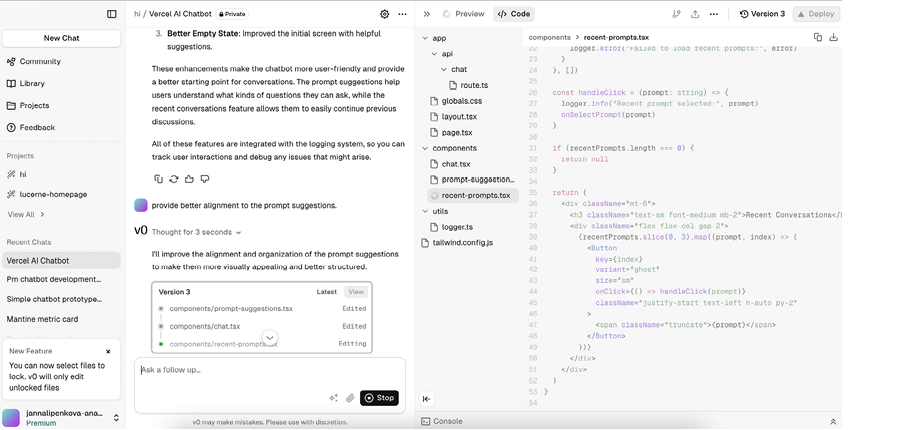
Use the hybrid-interface example to see how AI-driven interaction can coexist with familiar graphical actions such as Preview, Deploy, and Console. section 3.3.1
