A genotype is an organism’s complete genetic constitution: the combination of genes and alleles inherited from its parents. It provides a genetic blueprint for potential traits, while the phenotype consists of observable characteristics shaped by genotype–environment interaction. section 7.2.1
A genotype is built from several related biological units:
- Chromosomes contain DNA, genes occupy positions called loci, and alleles are variant forms of genes. section 7.2.1
- A gene combination can encode multiple traits, such as appetite, movement, feet, and skin type. section 7.2.1
- In genetic algorithms, a genotype can be represented computationally as a chromosome, such as a list of binary digits that decodes to a candidate value. section 7.4
From traits to a binary candidate
A toy organism might have appetite H, movement R, feet HV, and skin F as allele values. In a ticket-pricing genetic algorithm, an eight-bit genotype such as [1, 1, 1, 0, 1, 0, 0, 0] decodes to a price candidate, which a fitness function evaluates by profit. section 7.2.1 section 7.4
Figure 7.4 Genotype, phenotype, and taxonomic classification
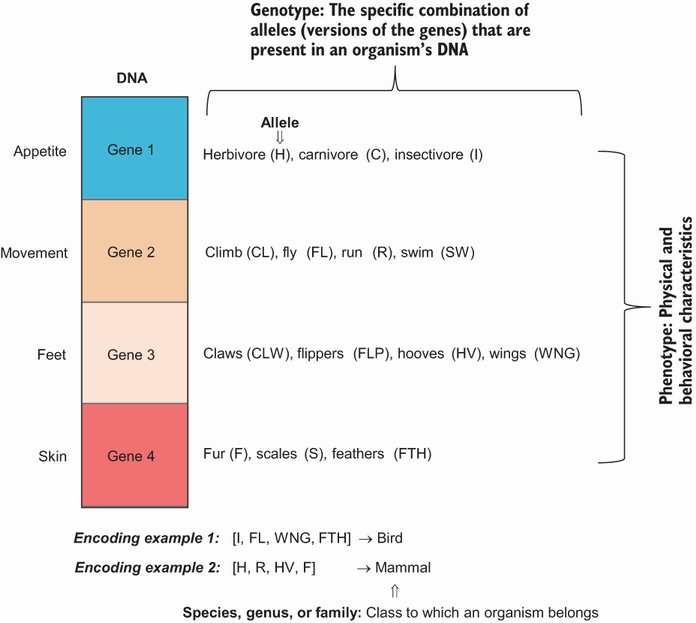
Use the figure to compare genotype, phenotype, and taxonomic classification. section 7.2.1

