liveBook · Manning

getForObject()

As explained in Spring in Action, Sixth Edition

getForObject() is a RestTemplate operation that performs an HTTP GET request and returns the response body converted to a specified object type.

getForObject() is a RestTemplate operation for sending an HTTP GET request and returning the response body converted into a specified object type. It fits straightforward resource retrieval when the payload is more important than response headers. section 7.3 section 7.3.1

Use the overloaded operation with one of these URL and variable forms:

  • Pass a URL string, the response class, and positional values for placeholders such as {id}. section 7.3.1
  • Pass a URL string, the response class, and a Map whose keys match the URL placeholders. section 7.3.1
  • Build a URI from a template and variable map, then pass the URI and response class. section 7.3.1

Fetching an ingredient by ID

public Ingredient getIngredientById(String ingredientId) { return rest.getForObject( "http://localhost:8080/ingredients/{id}", Ingredient.class, ingredientId); } The ingredientId value fills the {id} placeholder. The response body, likely JSON, is deserialized into an Ingredient object. section 7.3.1

Create RestTemplate directly where needed or declare it as a bean for injection. Choose getForEntity() instead when the client also needs response details such as headers; it wraps the mapped object in ResponseEntity. section 7.3 section 7.3.1

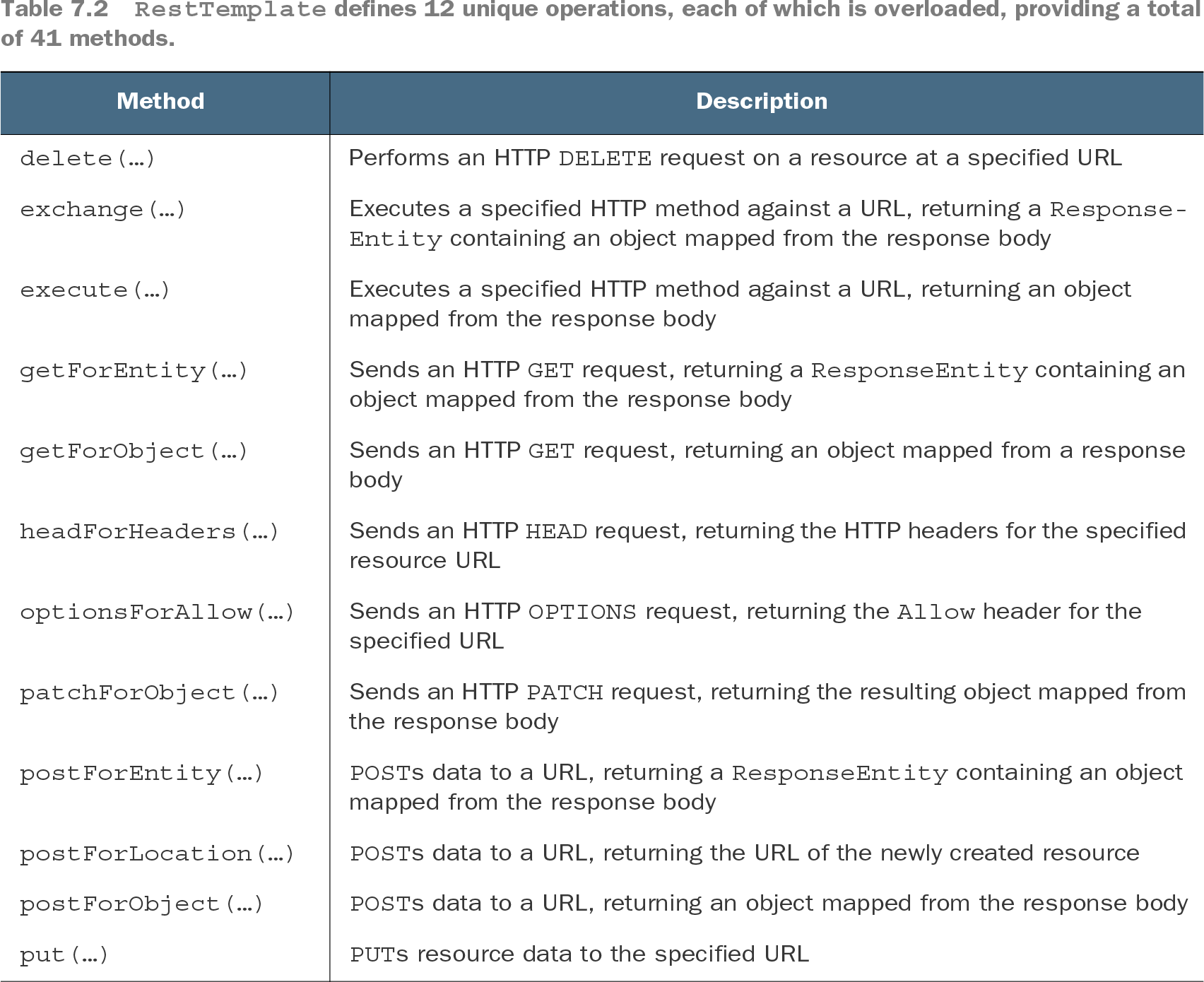
Table 7.2 RestTemplate defines 12 unique operations, each of which is overloaded, providing a total of 41 methods. (view table figure)

Method

Description

delete(...)

Performs an HTTP DELETE request on a resource at a specified URL

exchange(...)

Executes a specified HTTP method against a URL, returning a ResponseEntity containing an object mapped from the response body

execute(...)

Executes a specified HTTP method against a URL, returning an object mapped from the response body

getForEntity(...)

Sends an HTTP GET request, returning a ResponseEntity containing an object mapped from the response body

getForObject(...)

Sends an HTTP GET request, returning an object mapped from a response body

headForHeaders(...)

Sends an HTTP HEAD request, returning the HTTP headers for the specified resource URL

optionsForAllow(...)

Sends an HTTP OPTIONS request, returning the Allow header for the specified URL

patchForObject(...)

Sends an HTTP PATCH request, returning the resulting object mapped from the response body

postForEntity(...)

POSTs data to a URL, returning a ResponseEntity containing an object mapped from the response body

postForLocation(...)

POSTs data to a URL, returning the URL of the newly created resource

postForObject(...)

POSTs data to a URL, returning an object mapped from the response body

put(...)

PUTs resource data to the specified URL

Browse the RestTemplate operation table to compare getForObject() with getForEntity(), exchange(), execute(), and other HTTP operations. section 7.3

How Spring in Action, Sixth Edition covers it

How deep it goes
Explains return mapping, three URL-variable forms, and the boundary with getForEntity(), without detailing HTTP client internals.
Examples
Demonstrates fetching an Ingredient by ID with positional variables, a Map, and a constructed URI.
What it assumes
Assumes a RestTemplate instance and a target domain type such as Ingredient, while introducing URL placeholders and variable binding.
What you can do after
Apply it via RestTemplate to fetch a resource and deserialize its response body into a chosen object type.
How it connects
Ties RestTemplate to HTTP GET, URI templates, object deserialization, getForEntity(), and ResponseEntity.

Related concepts

This explainer was generated by Manning's knowledge graph from the text of Spring in Action, Sixth Edition. The section links point to the parts of the book it draws on.