liveBook · Manning

GitHub team

As explained in Effective Platform Engineering

A GitHub team is a named group of GitHub organization members used to manage shared repository access and membership.

A GitHub team is a named group of organization members used to track team membership and derive authorization through GitHub authentication. In a platform environment, it can serve as the membership source for access to control-plane services and clusters. section 8.5

A platform can use GitHub teams to:

  • Authenticate users through OIDC and authorize them according to their GitHub team. section 8.5
  • Bind a platform-building team to cluster permissions with a ClusterRoleBinding. section 8.5
  • Trigger onboarding automation that creates environment-specific namespaces and RoleBindings for a customer team, such as payments-dev, payments-qa, payments-preview, and payments-prod. section 8.5
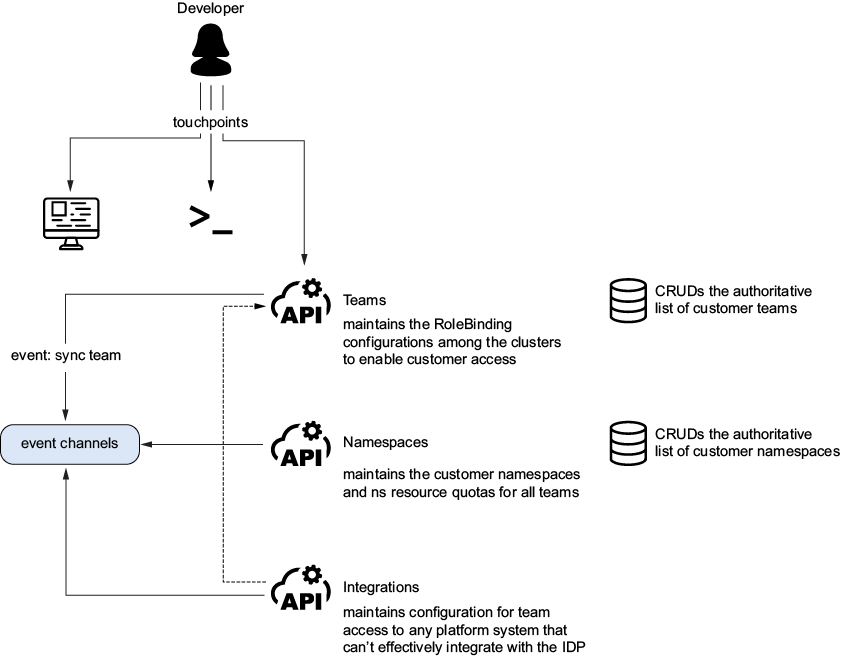
Figure 8.9 A “teams” API can be the interface to onboard a team and maintain the authoritative database for customer teams. This API will maintain the correct RoleBindings on the respective clusters. It can also populate the “sync team” events stream to which other services can subscribe.
A diagram of a computer system

AI-generated content may be incorrect.

A teams API can make team onboarding and membership authoritative while maintaining cluster RoleBindings and publishing synchronization events for other services. section 8.5

How Effective Platform Engineering covers it

How deep it goes
Connects team membership to OIDC, ClusterRoleBinding, RoleBinding, namespaces, and synchronization automation.
Examples
Uses a platform-building team and a payments team with separate development, testing, preview, and production environments.
What it assumes
Assumes GitHub credentials and an OIDC integration, while contrasting GitHub authority with Active Directory or another corporate identity system.
What you can do after
Operate team-based access and automate environment onboarding across clusters.
How it connects
Links GitHub teams with OIDC, authorization, identity providers, Kubernetes RoleBindings, namespaces, and control-plane services.

Related concepts

This explainer was generated by Manning's knowledge graph from the text of Effective Platform Engineering. The section links point to the parts of the book it draws on.