Global structure describes the overall arrangement and distances among all data points across an entire representation. In dimensionality reduction, preserving it helps reveal how clusters relate across chemical space. section 7.1.4
UMAP considers both global and local structure, although it emphasizes local relationships. It first measures high-dimensional distances and similarity scores, then uses them to arrange a low-dimensional graph. section 7.1.4
Social-network analogy
Local structure identifies small groups of friends who spend time together; global structure shows how all those groups relate across the entire network. In chemical datasets, the analogous view exposes relationships among chemical series and activity clusters. section 7.1.4
Figure 7.6 UMAP develops an understanding of local relationships by calculating the distances between each pair of points in high-dimensional space, and using these as the basis for high-dimensional similarity scores that are used to move low-dimensional projects of the points closer or further from one another.
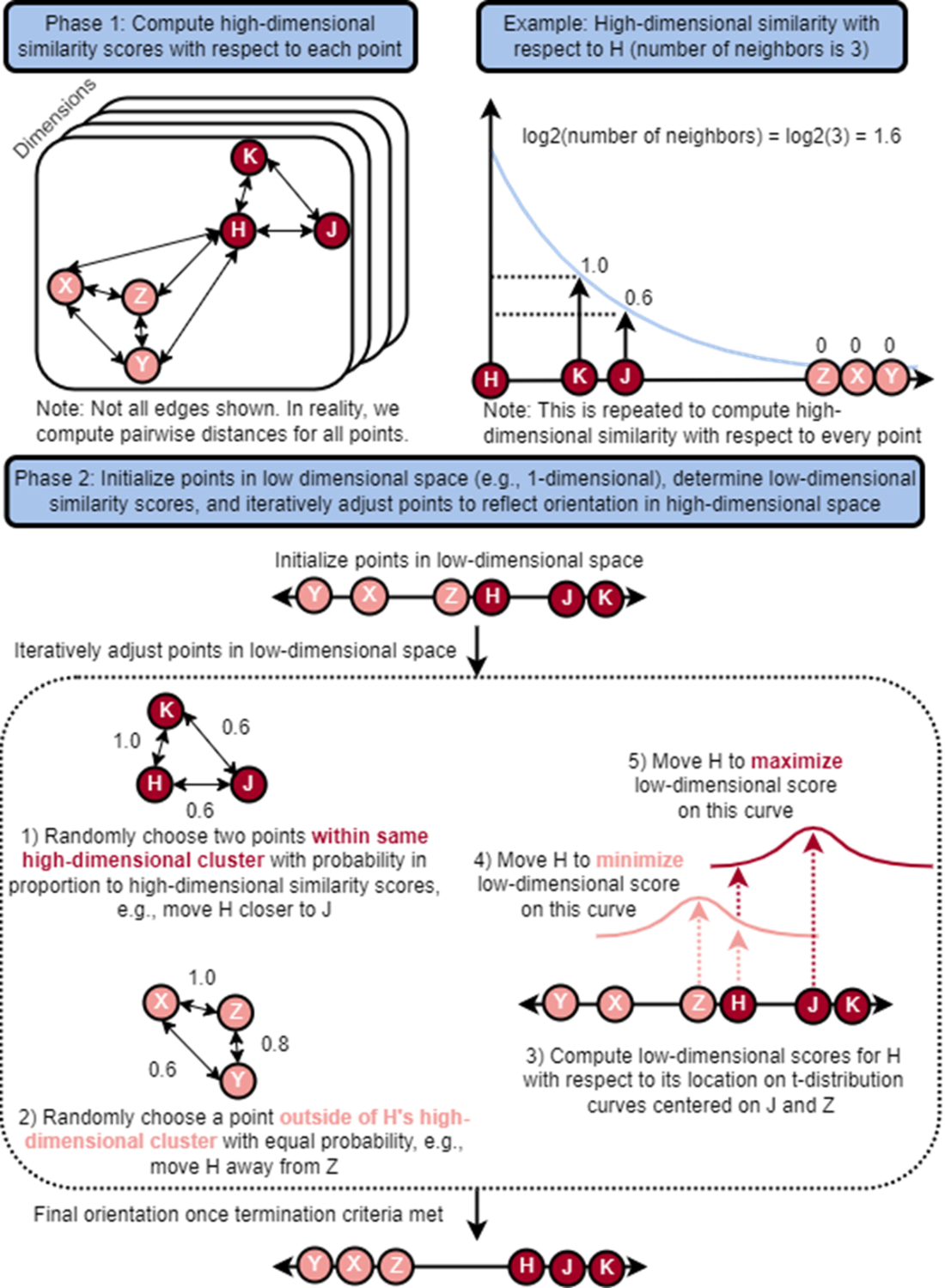
Follow UMAP’s transition from high-dimensional distances and similarity scores to a low-dimensional arrangement of points. section 7.1.4
