GloVe is an unsupervised, frequency-based model that represents words as compact vectors learned from global co-occurrence patterns. Words used similarly receive similar representations, helping capture semantic relationships with far fewer dimensions than one-hot encoding. section 7.13 section 7.14
GloVe differs from related text-representation approaches in several practical ways:
- Builds a co-occurrence matrix from how frequently words appear in context, rather than predicting context directly. section 7.14
- Combines matrix factorization with local-context learning associated with Word2Vec. section 7.14
- Captures relationships such as synonyms and correspondences between cities and zip codes. section 7.14
- Produces compact, meaningful vectors that preserve contextual relationships more effectively than basic one-hot representations. section 7.13 section 7.20
Semantic relations in vector space
Word embeddings can encode analogous relationships: the vector relation from “men” to “women” is presented as similar to the relation from “king” to “queen.”
Figure 7.16 Word embeddings can be used to represent the relationships between words. For example, there is a relation from “men” to “women” that is similar to “king” to “queen” as both “men-women” and “king-queen” represent the male-female gender relationship.
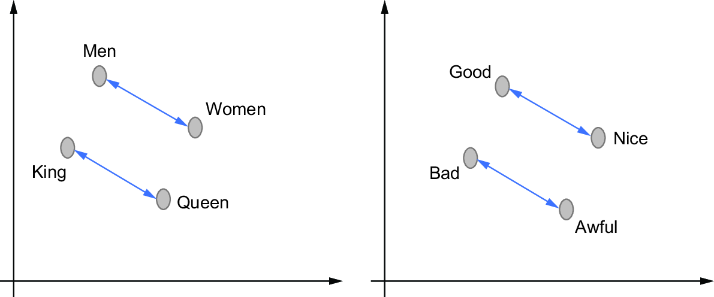
Use the figure to inspect how vector differences can express semantic relationships between word pairs. section 7.13

