A goodness-of-fit test is a chi-square test that compares observed category frequencies in one sample with expected frequencies. It asks whether the observed distribution differs from an expected distribution. section 5.2.3
Use it to identify disproportionality against fixed expectations or relative proportions. Distinguish it from tests of independence, which compare two categorical variables, and tests for trend, which examine patterns across time or groups. section 5.2.3
Interpret the comparison by considering:
- Observed frequencies: the category counts or proportions collected from the sample. section 5.2.3
- Expected frequencies: the counts or proportions predicted under the null hypothesis of no differences between categories. section 5.2.3
- Sample size: larger samples detect smaller differences more readily, while smaller samples make differences harder to detect. section 5.2.3
Figure 5.12 Breakdown of the equation for the X2 (chi-square) test
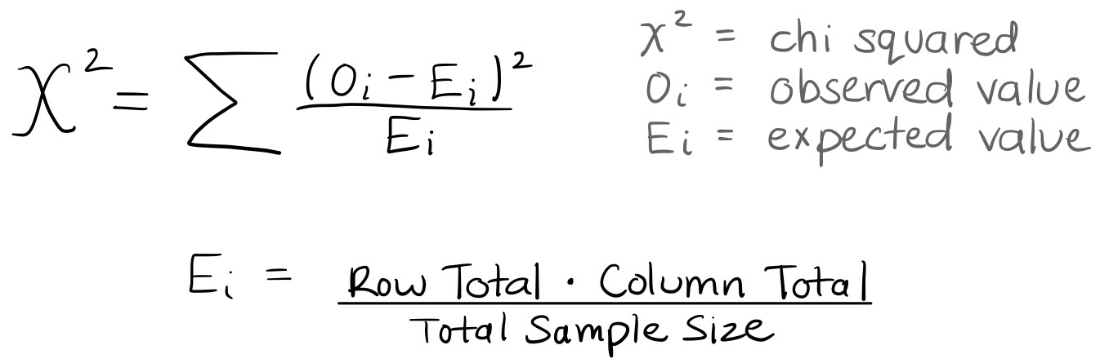
Use the chi-square equation breakdown to connect each category’s observed and expected frequency difference to the overall test statistic. section 5.2.3
