liveBook · Manning

Fuzzy foreign key

As explained in AI-Powered Search

A fuzzy foreign key is a non-strict relationship identifier whose matches require resolving different representations of the same entity.

A fuzzy foreign key joins unstructured documents when different representations resolve to the same entity rather than matching the same token exactly. section 2.1.3

Resolving shared entities

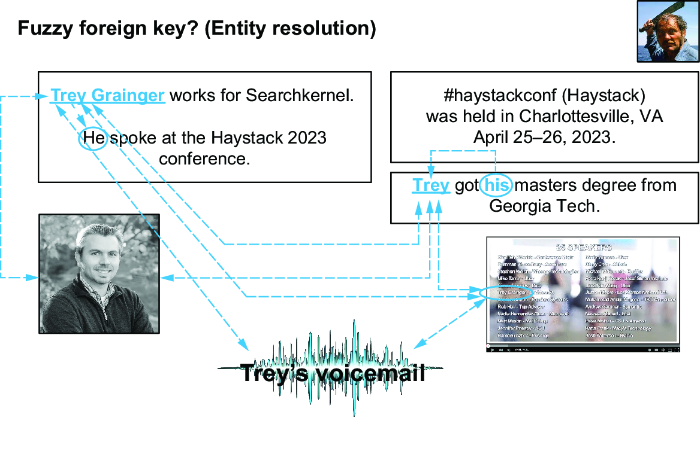
Documents can connect “Trey Grainger” with “Trey”, and can also resolve “he” or “his”, images, and videos to the same person. Likewise, separate documents mentioning “Haystack” can be related through that shared reference. section 2.1.3

Figure 2.5 Fuzzy foreign keys. In this example, the same entity is being referenced using different terms, and a join is occurring based upon multiple phrases resolving to the same entity.
figure

Shows a join occurring when multiple phrases resolve to the same entity instead of matching identical terms. section 2.1.3

How AI-Powered Search covers it

How deep it goes
Explains the contrast with strict token matching and requires additional natural-language processing, but does not specify particular algorithms.
Examples
Uses “Haystack”, “Trey Grainger”, “Trey”, pronouns, images, and videos as cross-document references.
What it assumes
Assumes familiarity with foreign-key relationships while introducing entity resolution for unstructured information.
What you can do after
Evaluate/understand how differently expressed references can join documents around a shared entity.
How it connects
Connects foreign keys with entity resolution, natural language processing, unstructured data, and multimodal document relationships.

Related concepts

This explainer was generated by Manning's knowledge graph from the text of AI-Powered Search. The section links point to the parts of the book it draws on.